
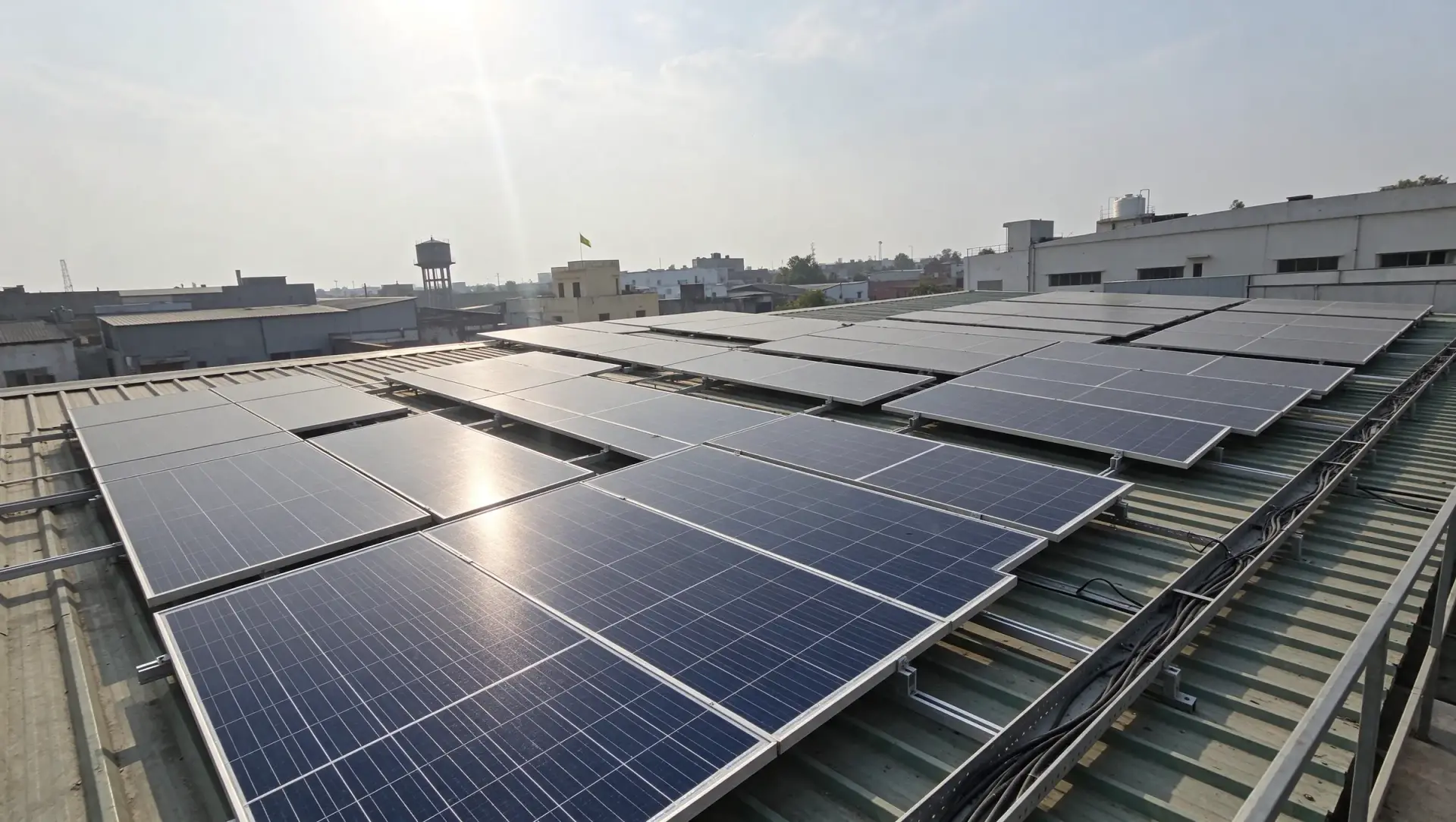
On Grid Vs Off Grid Solar For Factories: Cost & Backup
How on-grid and off-grid solar differ for a factory: system cost, battery backup, what happens in a power cut, net metering and which one suits the facility.
An on-grid solar system runs alongside the DISCOM supply and uses no battery. An off-grid solar system runs without the grid and depends on batteries. For a factory with a grid connection, on-grid is the lower-cost route, and batteries are added only where outages justify the spend.
India’s installed base reflects this split. As of 30 September 2026, MNRE data shows 33.41 GW of grid-connected rooftop solar against 6.63 GW of off-grid solar.
How The Two Systems Differ
| Parameter | On Grid Solar System | Off Grid Solar System |
|---|---|---|
| Grid connection | Connected to the DISCOM supply | Independent of the grid |
| Battery | Not required | Central to the design |
| Shortfall in generation | Drawn from the grid | Drawn from battery storage |
| During a grid outage | Shuts down | Continues, within battery and generation limits |
| Net metering | Available, subject to state rules | Not applicable |
| Upfront cost | Lower | Higher, driven by batteries |
| Maintenance | Panels, inverters, electrical checks | The same, plus batteries |
| Inverter | Grid-tied, synchronised with the grid | Standalone, managing battery charge and supply |
| Best suited for | Facilities with reliable grid access | Sites with no grid or an unreliable one |
Which Solar Model Fits Your Business?
Capex, Opex PPA, or Open Access — get a site-specific recommendation with system size, savings, and payback in 24 hours.
Why On-Grid Solar Stops In A Power Cut
Grid-tied inverters in India are required to disconnect automatically when the grid fails. This anti-islanding protection prevents the plant from energising lines that DISCOM staff may be repairing. The plant stays off, even in full sunshine, until supply is restored.
Backup during an outage needs a battery and an inverter designed to operate independently of the grid. That configuration is a hybrid or off-grid system, not a standard on-grid one.
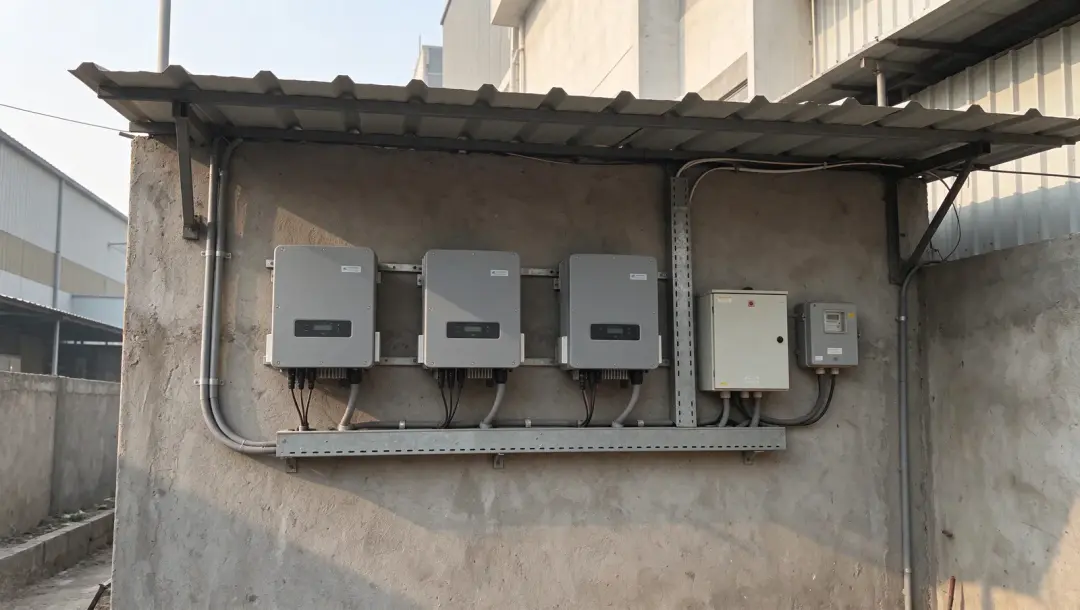
Grid-tied string inverters with an AC distribution box and meter box at an Indian factory.
What Backup Actually Costs
Backup is priced by energy stored, not by solar capacity, and storage is the expensive part.
| Item | Illustrative Figure |
|---|---|
| Critical load to be backed up | 50 kW for 4 hours |
| Battery capacity needed | 200 kWh usable |
| Installed industrial BESS cost | ₹37,000-62,000 per kWh |
| Battery cost for this backup | About ₹74 lakh-₹1.24 crore |
| Typical 100 kW on-grid plant | About ₹40-60 lakh |
Backing up a 50 kW critical load for four hours can cost more than a 100 kW solar plant. The figures are for illustration, and actual costs depend on the system and site.
Published off-grid price lists show the same pattern: the lithium battery alone accounts for roughly half or more of system cost. This is why fully off-grid plants are rare at factories with a grid connection.
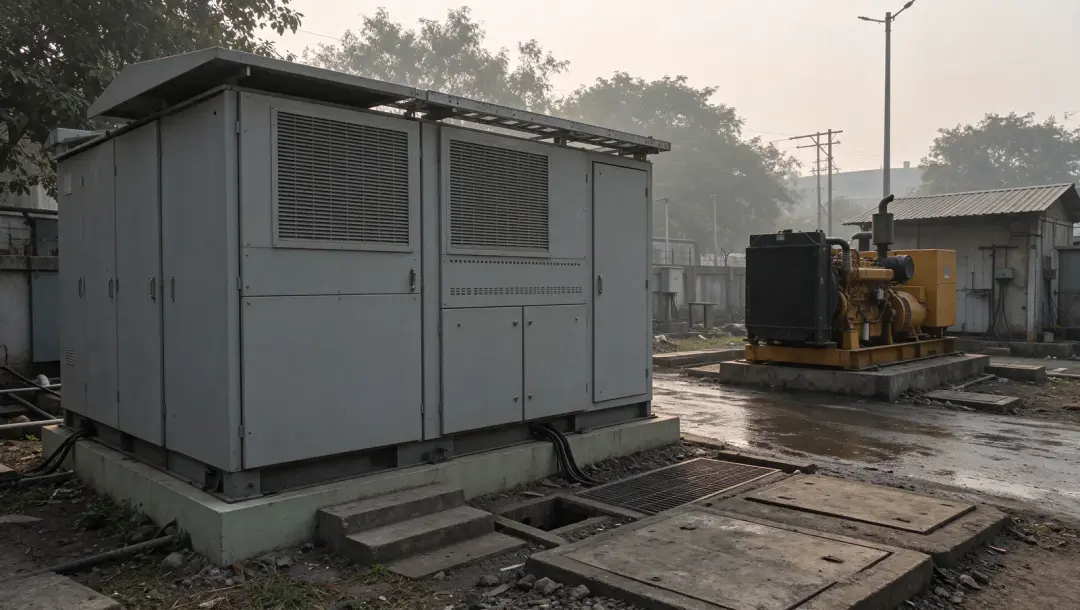
Battery storage cabinet beside a diesel generator set in an Indian factory yard.
Net Metering And Approvals
On-grid plants export surplus power and receive credit under net metering, within the rules of the state commission and DISCOM. Off-grid plants have no connection to export through, so surplus generation is either stored or wasted. Commercial and industrial buyers also have no central capital subsidy for either type, since PM Surya Ghar covers residential systems.
Which System Suits Which Facility
- On-grid suits factories, warehouses and commercial buildings with a stable grid connection and daytime-heavy consumption.
- Off-grid suits remote sites where grid supply is unavailable or unreliable.
- Hybrid (on-grid with battery) suits facilities where an outage carries a real cost, such as cold storage or continuous processes. Where diesel generators currently cover outages, power typically costs ₹25-35 per unit, so battery storage is worth evaluating against that figure.
Questions buyers ask us.
On-grid solar stays connected to the electricity grid and uses no battery. Off-grid solar works independently of the grid and relies on batteries.
No. Grid-tied inverters shut down when the grid fails, as a safety requirement, even when the sun is shining.
Usually, yes. Batteries and the standalone inverter add substantial cost, and batteries need replacing during the plant’s life.
No. Net metering applies only to grid-connected systems.
Not by adding batteries alone. A different inverter and electrical configuration is needed, so conversion is a redesign.
No. A grid-tied inverter synchronises with the grid, while an off-grid inverter must run loads and manage batteries on its own.
No central capital subsidy applies to commercial and industrial systems. The benefits are electricity savings and depreciation.
Three inputs decide the configuration: how reliable the grid is, what an outage costs, and how large the critical load is. PowerMore sizes backup against the critical load, not the whole plant load, so battery spend stays in proportion to the risk it covers.
Speak To Our Team To Choose The Right Solar System For Your Facility.