
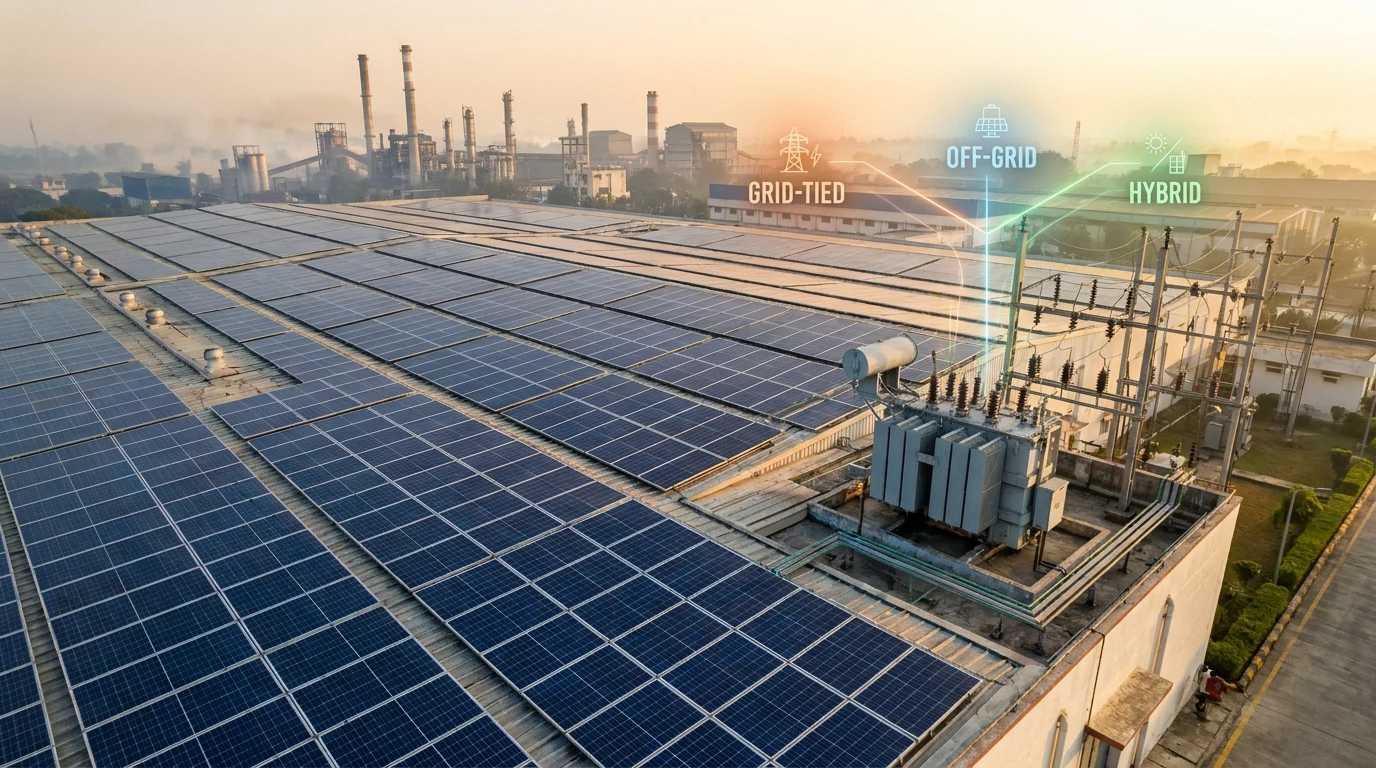
On-Grid Vs Off-Grid Vs Hybrid Solar Systems: Which One Is Right For Your Business?
On-grid, off-grid, or hybrid — the right commercial rooftop solar system depends on your grid quality, backup needs, and payback expectations. Here's how each model actually works, and which one fits your business.
Every business owner evaluating rooftop solar runs into the same three-way choice early on: on-grid, off-grid, or hybrid.
The names sound technical, but the decision is really about three simple things — how reliable your grid is, whether you need backup during outages, and how quickly you want to see payback.
Pick the wrong system for your load profile and you either overspend on batteries you never use, or install a plant that switches off the moment the DISCOM does.
Here's how each of the three commercial rooftop solar models actually works, where each one shines, and how to decide which fits your factory, office park, warehouse, or hospital.
The Three Solar System Types, In One Line Each
On-grid solar sends power to your loads and exports the surplus to the utility grid. No batteries.
Off-grid solar disconnects from the utility entirely and runs your site on solar plus a battery bank.
Hybrid solar combines both — panels feed your loads, batteries hold reserve for outages, and the grid stays connected for the rest.
That's the whole framework. Everything else is detail on top.
Which Solar Model Fits Your Business?
Capex, Opex PPA, or Open Access — get a site-specific recommendation with system size, savings, and payback in 24 hours.
On-Grid Solar Systems
An on-grid or grid-tied system is the most common commercial rooftop solar setup in India, and for most businesses it's also the most economical.
Solar panels on the roof generate DC electricity. A grid-tied inverter converts it to AC and feeds it directly into your facility's main distribution board. Anything your loads don't consume immediately is exported to the DISCOM grid through a net-metering connection, and you earn credit against your future consumption.
There are no batteries in the picture. When the grid goes down, the inverter shuts off for safety (this is called anti-islanding), so the site loses solar generation too until the grid is back.
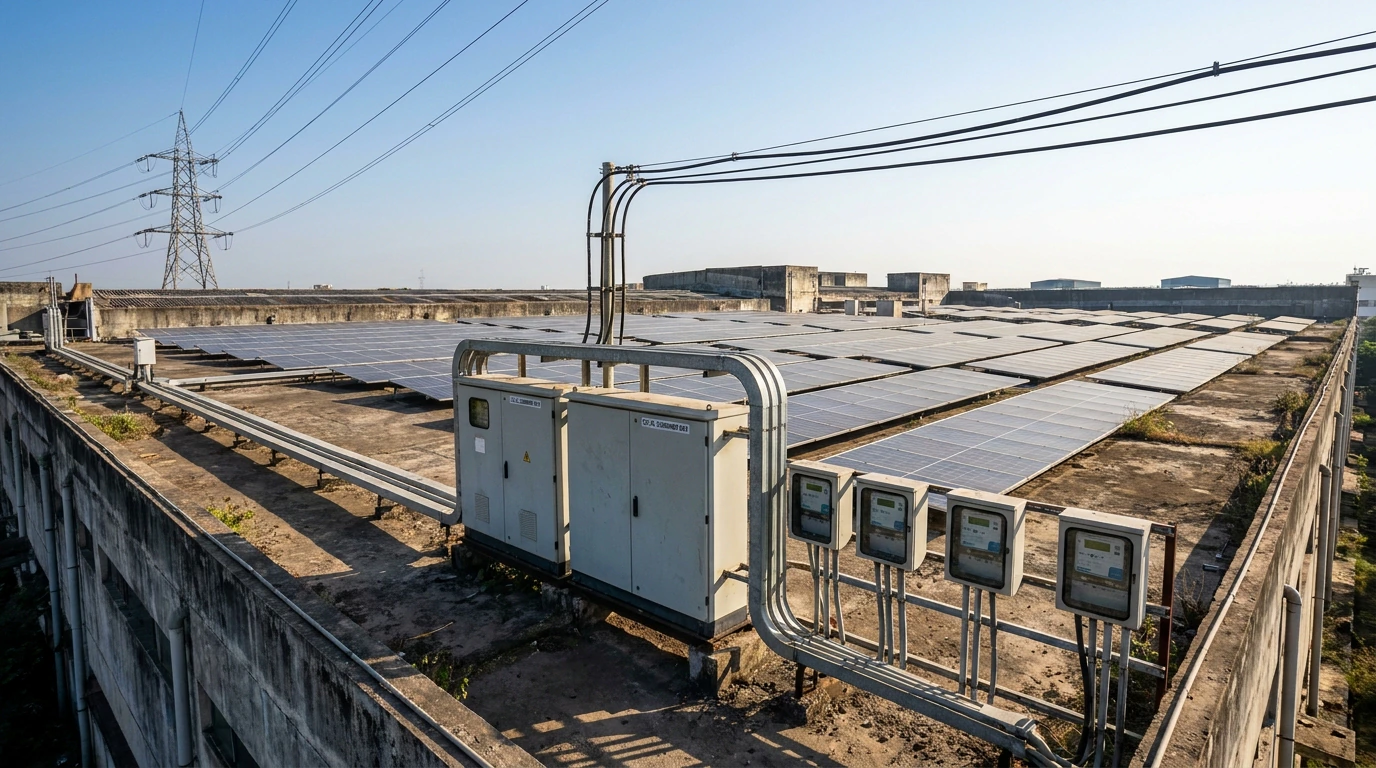
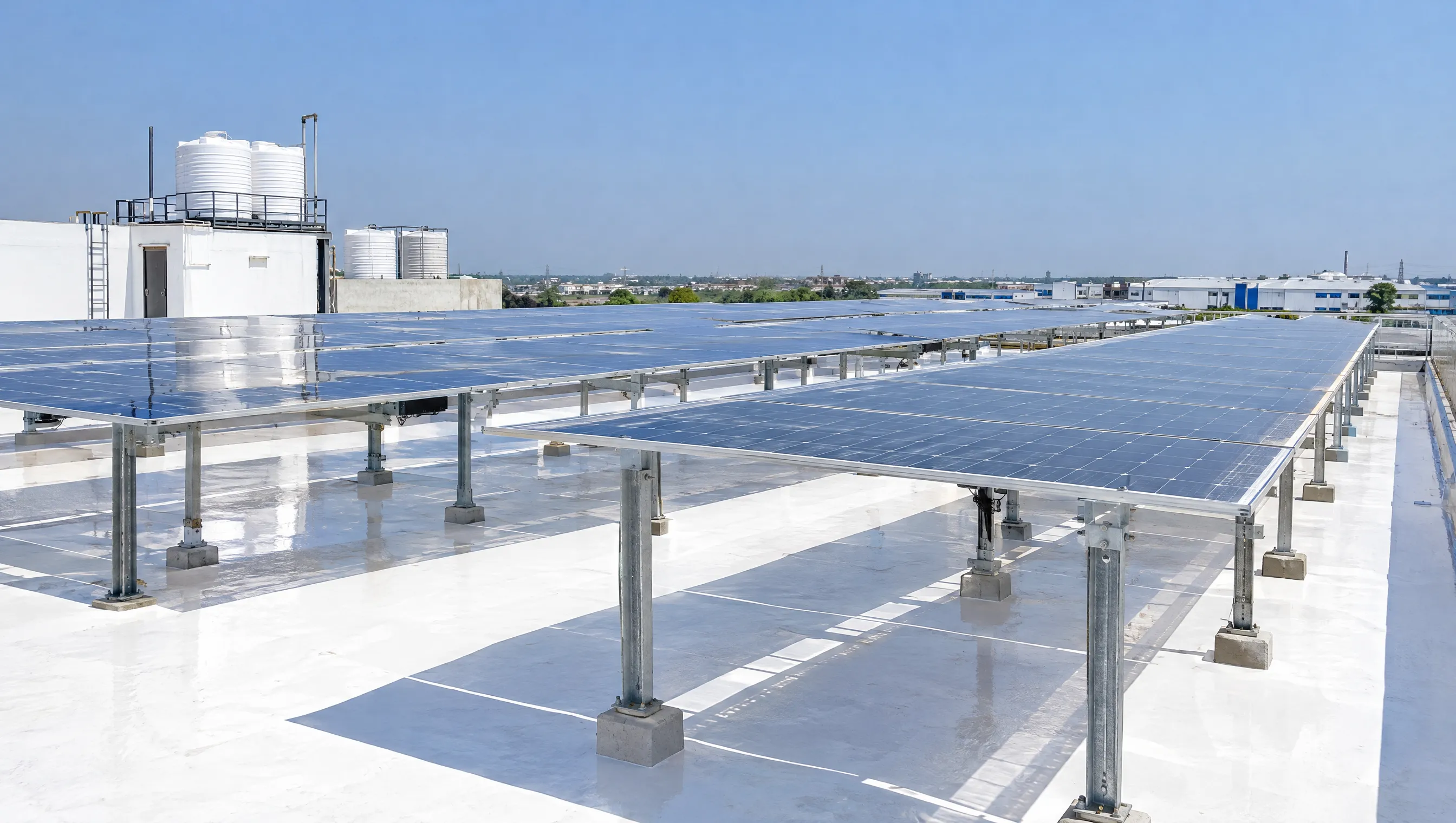
On-grid commercial rooftop solar with net-metering equipment and grid connection lines running to the transformer at the roof edge.
Where On-Grid Solar Wins
- Any site with a reasonably stable grid (typical urban and industrial areas)
- Businesses where daytime consumption is high — factories, offices, cold storage, data centres
- Anyone optimizing purely for the shortest payback period
The Trade-Off
You get no backup. If your operations can't tolerate the outage exposure your DISCOM already gives you, this alone isn't enough.
Typical Payback
Well-designed on-grid rooftop solar in India pays back in roughly 3.5 to 5 years for most commercial and industrial sites, with a useful life of 25+ years on the panels.
Off-Grid Solar Systems
An off-grid system does exactly what it sounds like — it operates completely independent of the utility grid.
Solar panels charge a battery bank during the day. A hybrid or off-grid inverter draws from those batteries to run your site around the clock. There is no grid connection, no net metering, and no export.
That independence comes at a cost. Batteries are expensive, they need replacing every 8-15 years depending on chemistry, and you have to design the plant for your absolute worst-case day (monsoon week, cloudy stretch) rather than average generation.
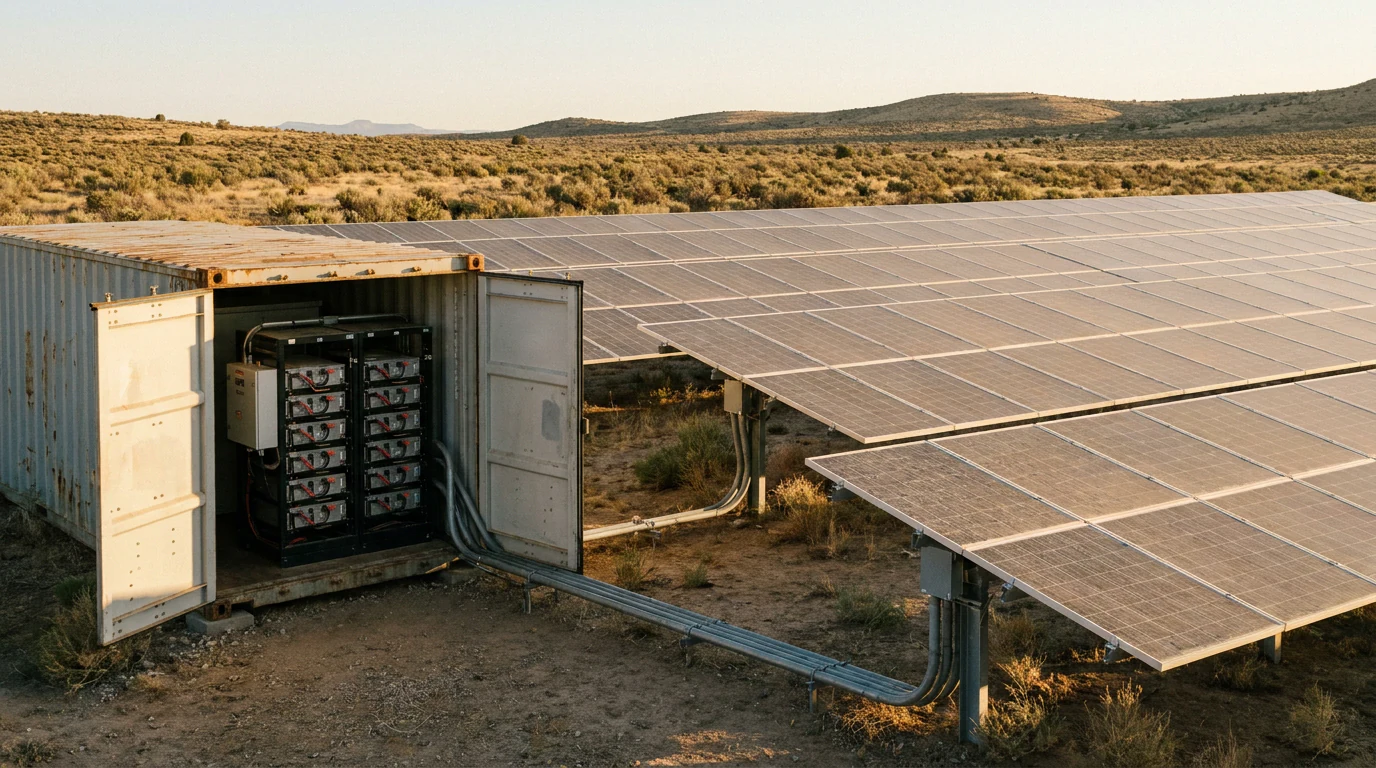
Off-grid ground-mounted solar with a nearby lithium battery bank at a remote industrial site in India.
Where Off-Grid Solar Wins
- Remote sites where a grid connection is unavailable or prohibitively expensive to bring in
- Telecom towers, mining installations, agricultural pump sets in villages, forest lodges, off-grid warehouses
- Businesses that genuinely need full energy independence for strategic reasons
The Trade-Off
Higher upfront cost, ongoing battery replacement, and system sizing has to be conservative — you can't count on the grid to cover a bad-weather week.
When It's Not The Right Answer
If your business already has grid access, off-grid almost always makes less financial sense than hybrid. You'd be paying to duplicate infrastructure the DISCOM already gives you.
Hybrid Solar Systems
A hybrid system combines panels, batteries, and the grid — and lets a smart inverter decide moment-to-moment where power should come from and go to.
Typical operation: during the day, solar directly serves your loads. Any surplus first tops up the battery bank, and only then exports to the grid. In the evening, your site draws from the batteries until they reach the reserve threshold, then falls back to grid supply. During a DISCOM outage, the inverter islands your critical loads onto the battery-plus-solar micro-grid without interruption.
You get the export credit of an on-grid plant plus the backup of an off-grid plant, in one system.
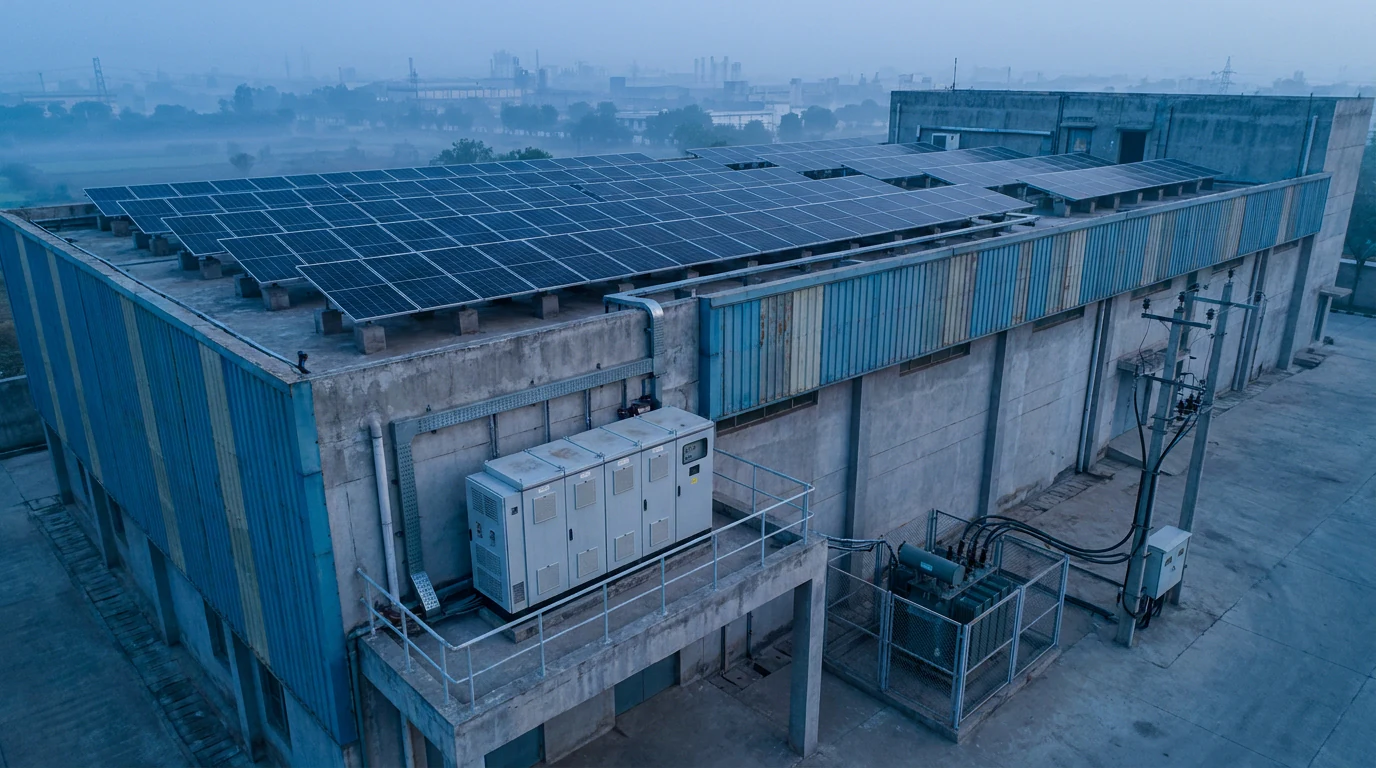
Hybrid solar system on a data centre rooftop — panels on the roof, battery cabinet on a lower platform, and grid connection running to the transformer.
Where Hybrid Solar Wins
- Hospitals, data centres, cold storage, telecom hubs — any operation where an unplanned outage is genuinely expensive
- Manufacturing sites with sensitive processes that can't tolerate the DISCOM's outage profile
- Businesses in areas with frequent, unpredictable grid failures
- Anyone running a large DG (diesel genset) today who wants to displace both the fuel and the emissions
The Trade-Off
More expensive than pure on-grid (batteries add 30-60% to system cost depending on how many hours of backup you specify), and the payback is longer — typically 5-7 years — because you're paying for two capabilities at once.
How To Pick The Right System For Your Business
The decision comes down to four questions, in order:
1. Do You Have Reliable Grid Access?
If no — off-grid is the only real option. If yes, on-grid or hybrid.
2. What Does A Grid Outage Actually Cost You?
If an outage means a shift stops, a batch spoils, or a data centre trips, hybrid pays for itself even at the longer payback. If you can absorb the DISCOM's outage profile without material loss, on-grid is the better financial choice.
3. What's Your Daytime Vs Nighttime Load Split?
If most of your consumption is during daylight (typical factory, office, warehouse, cold storage), on-grid captures nearly all the value of solar with none of the battery cost. If you have substantial evening or 24×7 load and need to time-shift solar into off-hours, hybrid is worth the extra investment.
4. What's Your Payback Target?
Under 5 years — on-grid, almost always. 5 to 7 years, willing to trade some payback for reliability — hybrid. Under any circumstance where grid is available, off-grid rarely produces the best payback.
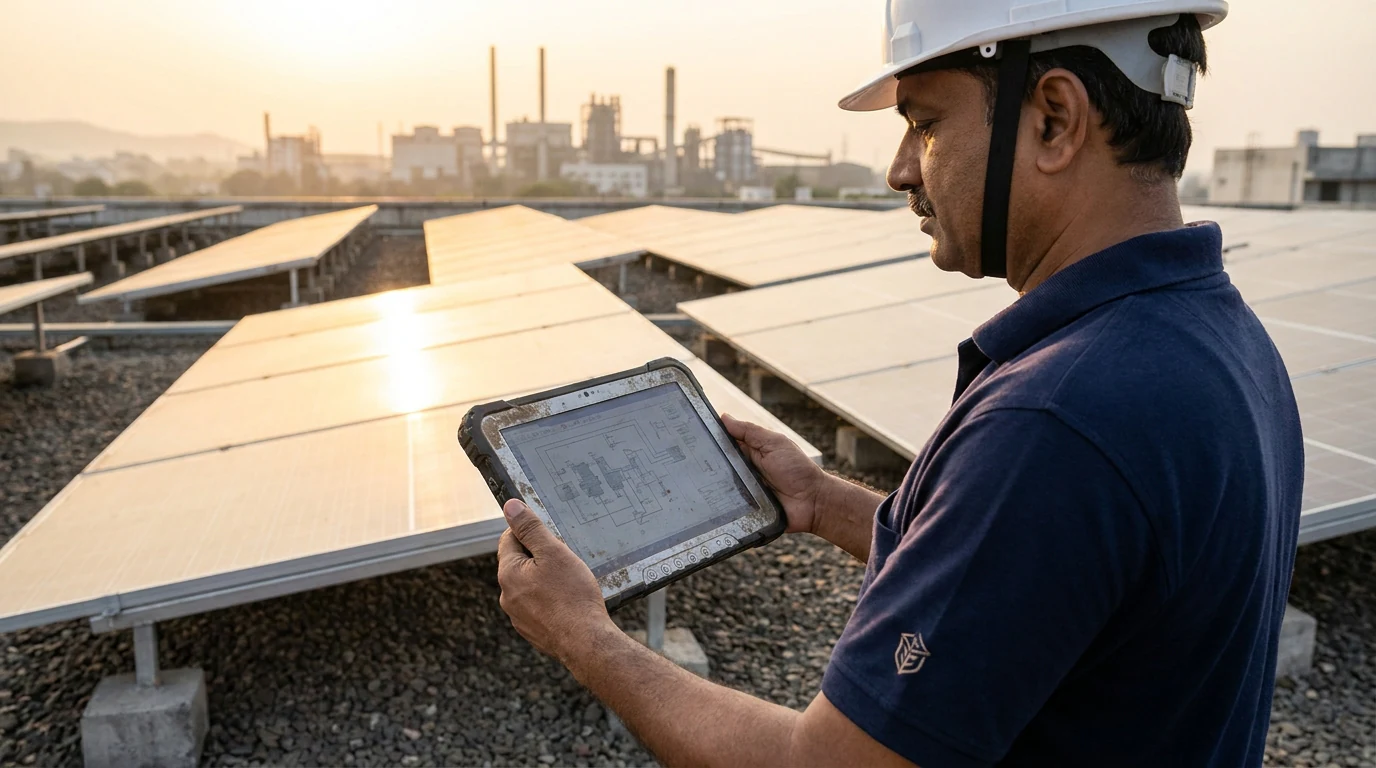
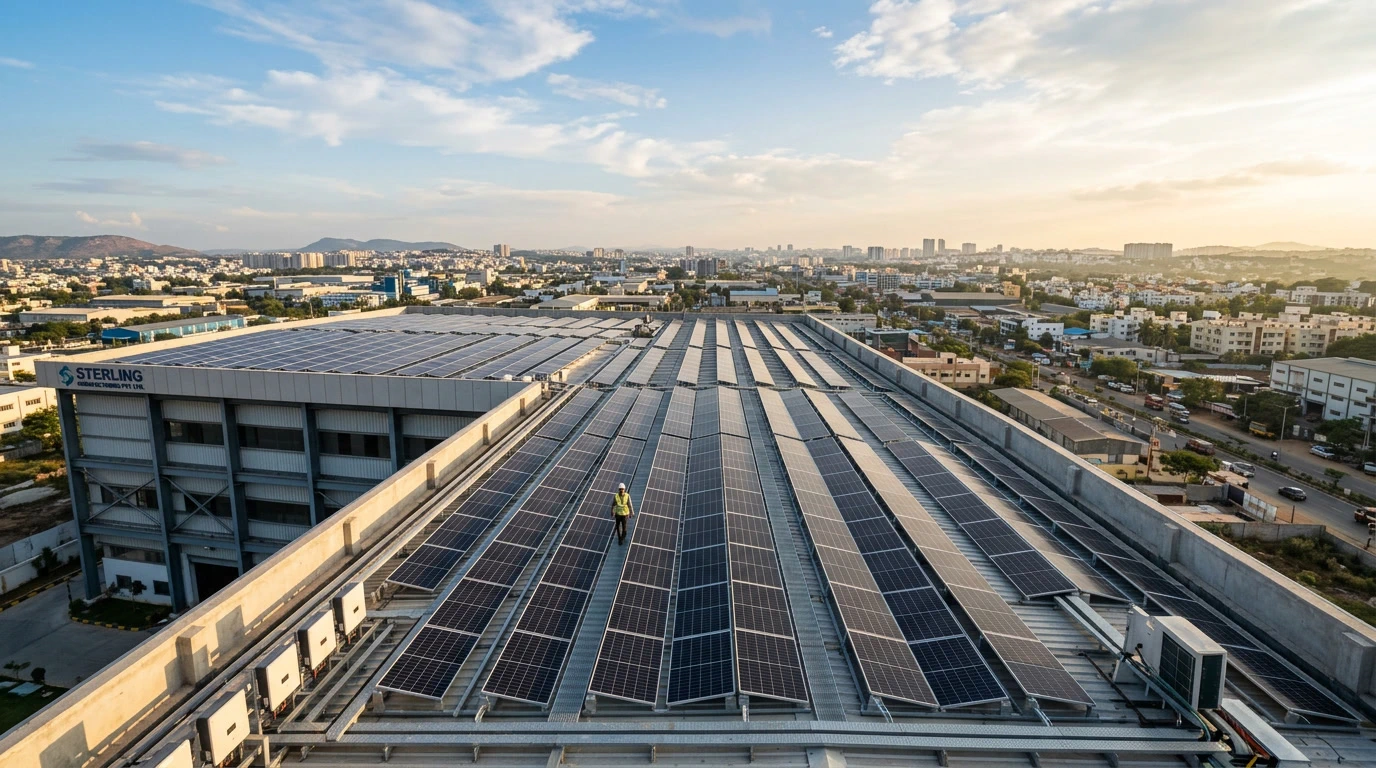
Solar EPC engineer reviewing system design options on a rooftop at golden hour.
Quick Comparison
Grid Dependence
On-grid stays connected to the utility. Off-grid is fully independent. Hybrid stays connected but can also island.
Backup Power
On-grid provides none. Off-grid runs entirely on batteries. Hybrid provides seamless backup for critical loads.
Upfront Cost
On-grid is the lowest. Hybrid is mid-to-high. Off-grid is the highest, driven mostly by battery sizing.
Payback Period
On-grid pays back fastest (typically 3.5 to 5 years). Hybrid takes 5 to 7 years. Off-grid depends heavily on the alternative you're replacing.
Best Fit
On-grid for grid-connected commercial and industrial. Off-grid for remote sites. Hybrid for outage-sensitive operations.
Common Mistakes We See
Over-specifying batteries "just in case." Every kWh of battery adds significant cost. Size backup to what your business truly cannot afford to lose during an outage, not what feels comfortable.
Choosing off-grid because a competitor did. Nine times out of ten, that competitor's site has no grid access. If yours does, hybrid gives you the same operational independence for a fraction of the CAPEX.
Ignoring the DG your hybrid can replace. Sites running diesel gensets today often find hybrid solar has the fastest payback of the three, because the alternative fuel cost is enormous.
Assuming on-grid means "unreliable." For a business whose operations track daylight hours, on-grid captures 95%+ of solar's value with the simplest, cheapest, longest-lived plant.
Questions buyers ask us.
Only if you have no grid access or a truly strategic need for full independence. For a grid-connected commercial or industrial site, on-grid or hybrid almost always beats off-grid on economics.
Yes, if the inverter is battery-ready at the design stage. Retrofitting batteries onto a pure on-grid inverter usually means replacing the inverter, so plan this at Day 1 if there's any chance you'll want backup later.
In most Indian states, yes. The hybrid inverter exports surplus to the grid through the same net-metering connection as an on-grid plant.
On-grid, in almost every commercial and industrial case with grid access. Hybrid is close behind if the site currently runs a DG for outages, because you're displacing an expensive alternative.
Solar panels last 25+ years across all three system types. The difference is the battery, which typically needs replacement every 8-15 years depending on chemistry and cycling.
We start every commercial project with a site assessment that measures your actual load profile, DISCOM reliability, roof geometry, and shading — before recommending a system type. In our experience, on-grid fits about 70% of commercial and industrial sites in India, hybrid fits another 25% (heavily weighted toward hospitals, data centres, cold storage, and outage-sensitive manufacturing), and off-grid is genuinely required only in the last 5%.
If you'd like a straight answer for your specific facility, our team can put together a right-sized recommendation with the numbers behind it.
Talk to a PowerMore engineer for a free rooftop assessment.