
Can The OPEX Solar Model Maximize Savings For Your Business?
The OPEX solar model lets commercial and industrial businesses adopt rooftop solar with zero upfront investment and pay only for the units they consume. Here's how it works, where it fits, and how to evaluate it against CAPEX.
For businesses looking to adopt solar energy, one of the biggest decisions is not whether to install solar, but how to finance it.
While some organizations choose to purchase and own a solar power system, others prefer a model that allows them to benefit from solar energy without making a large upfront investment.
This is where the OPEX solar model comes in.
Over the last few years, the OPEX model has emerged as a popular option for commercial and industrial consumers across India. It enables businesses to adopt solar power with minimal capital expenditure while enjoying the benefits of clean and cost-effective energy.
But can the OPEX solar model truly maximize savings?
Let's understand how it works.
What Is The OPEX Solar Model?
The OPEX (Operating Expenditure) solar model allows businesses to use solar energy without purchasing the solar system.
In this arrangement, a solar developer invests in, installs, owns, operates, and maintains the solar power plant.
The customer simply purchases the electricity generated by the system through a Power Purchase Agreement (PPA) at a pre-agreed tariff.
Instead of paying for the solar asset, the customer pays only for the energy consumed.
This significantly reduces the financial barrier often associated with solar adoption.

Two business executives reviewing a Power Purchase Agreement in a corporate boardroom, with a solar rooftop visible through the window.
Which Solar Model Fits Your Business?
Capex, Opex PPA, or Open Access — get a site-specific recommendation with system size, savings, and payback in 24 hours.
How Does The OPEX Model Work?
The process is relatively simple.
Step 1: Site Assessment
The solar developer evaluates the facility's energy consumption, rooftop availability, and technical feasibility.
Step 2: System Installation
The developer designs and installs the solar plant at its own cost.
Step 3: Power Purchase Agreement
A long-term agreement is signed between the customer and the developer specifying the tariff and contract duration.
Step 4: Energy Consumption
The business consumes the electricity generated by the solar system and pays only for the units consumed as per the agreed tariff.
Step 5: Operations & Maintenance
The developer remains responsible for monitoring, maintenance, servicing, and system performance throughout the agreement period.
How Does The OPEX Model Help Businesses Save?
The primary advantage of the OPEX model is that businesses can begin using solar energy without a significant upfront investment.
However, savings are not limited to capital expenditure alone.
Lower Electricity Costs
Solar power purchased under a PPA is often priced competitively compared to conventional grid electricity tariffs.
This allows businesses to optimize a portion of their electricity expenses while benefiting from greater cost predictability.
No Capital Blockage
Instead of allocating capital toward energy infrastructure, businesses can deploy funds toward:
- Business expansion
- New equipment
- Capacity enhancement
- Technology investments
- Working capital requirements
Reduced Maintenance Costs
Since the developer owns the asset, maintenance responsibilities generally remain with them.
This reduces operational burden and helps ensure consistent system performance.
Long-Term Cost Visibility
Most PPAs offer predefined tariff structures, helping businesses plan energy expenses more effectively over the long term.
Is The OPEX Model Suitable For Every Business?
Not necessarily.
The OPEX model is particularly attractive for organizations that:
- Prefer not to make a large upfront investment
- Want to preserve capital for core operations
- Seek predictable energy costs
- Prefer third-party maintenance and monitoring
- Want to accelerate renewable energy adoption
However, businesses looking for complete ownership of the solar asset and maximum lifetime savings may also evaluate CAPEX-based models.
The right approach depends on the organization's financial priorities and energy strategy.
Which Industries Commonly Adopt The OPEX Model?
The OPEX solar model is widely adopted across:
Manufacturing Facilities
Factories with high daytime electricity consumption often benefit from solar-generated power under long-term PPAs.
Warehouses And Logistics Parks
Large roof areas and consistent energy demand make these facilities ideal candidates for OPEX-based solar installations.
Commercial Buildings
Office campuses and commercial properties can improve sustainability performance while managing energy costs more efficiently.
Educational Institutions
Universities, schools, and large campuses frequently evaluate OPEX solutions due to budget allocation considerations.
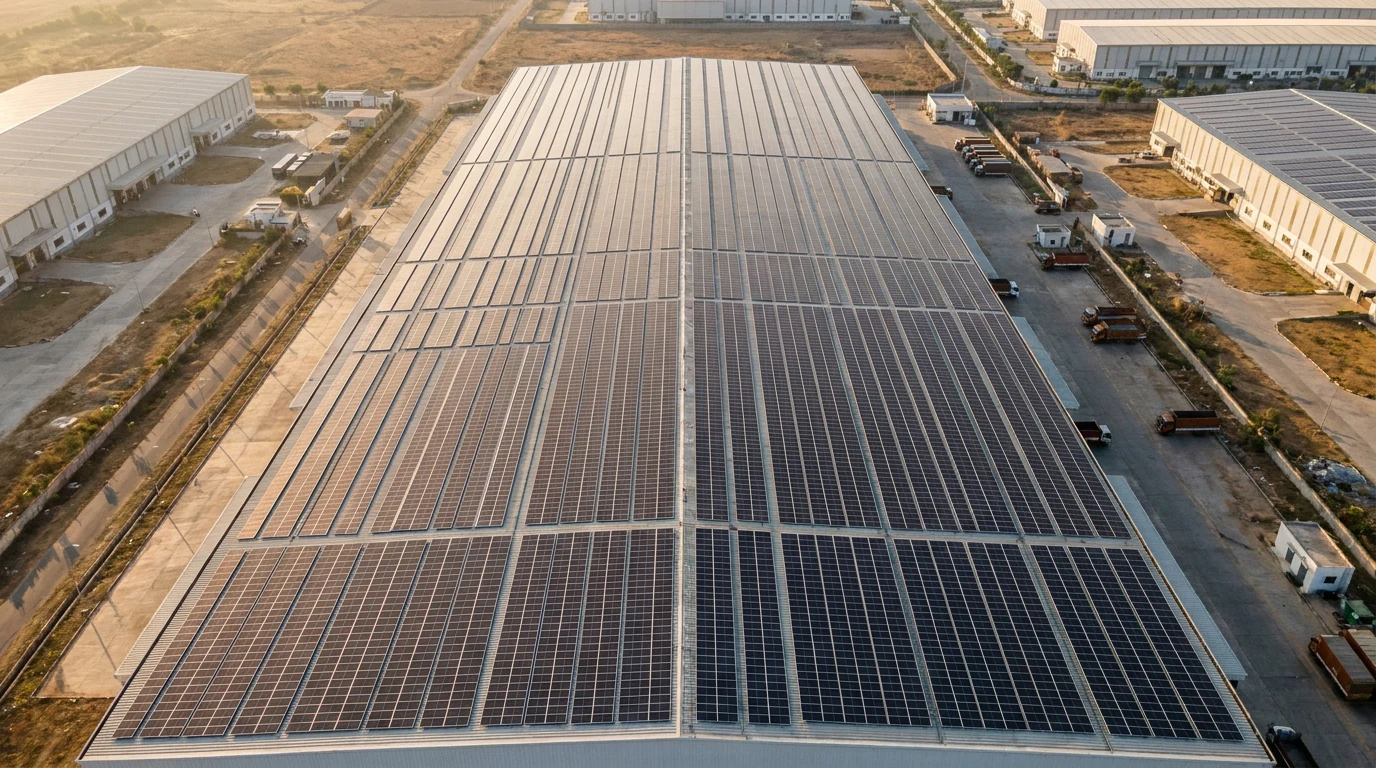
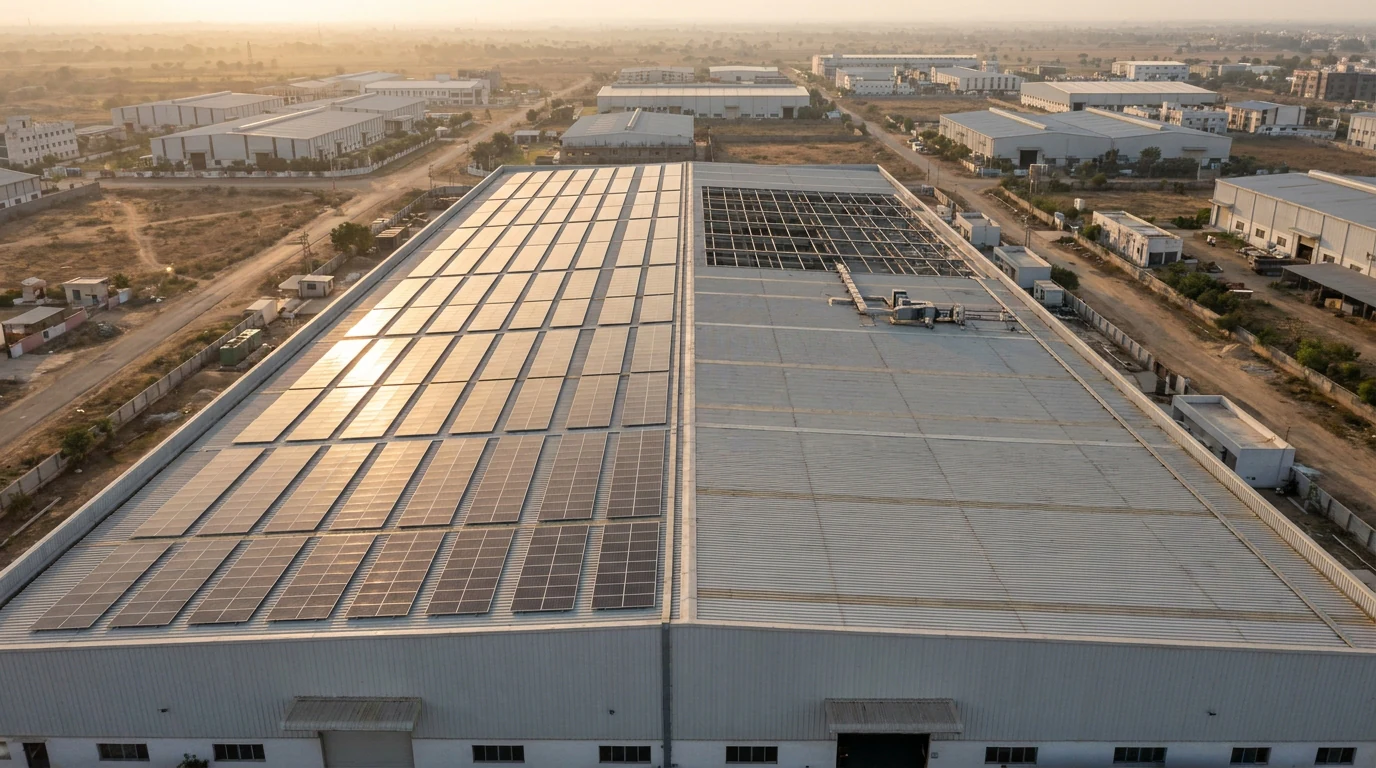
Aerial view of a large Indian logistics warehouse rooftop densely covered with monocrystalline solar panels at golden hour.
What Should Businesses Evaluate Before Choosing OPEX Solar?
Before opting for an OPEX arrangement, businesses should assess:
- Current electricity consumption
- Available installation space
- Contract duration
- Energy cost objectives
- PPA tariff structure
- Long-term operational plans
Working with an experienced solar partner can help businesses determine whether an OPEX model aligns with their energy and financial goals.
The Future Of OPEX Solar In India
As commercial and industrial solar adoption continues to grow, flexible financing structures are becoming increasingly important.
Many organizations today are seeking solutions that allow them to improve sustainability performance and reduce electricity costs without affecting capital allocation plans.
The OPEX model addresses this requirement by making solar energy more accessible and easier to adopt.
For businesses looking to transition to renewable energy while maintaining financial flexibility, it remains one of the most practical pathways available.
Questions buyers ask us.
An OPEX solar model allows businesses to use solar energy without owning the solar power plant. The customer pays only for the electricity generated through a Power Purchase Agreement (PPA).
A Power Purchase Agreement (PPA) is a contract through which a customer purchases electricity generated by a third-party-owned solar plant at a predetermined tariff.
No. Under the OPEX model, the solar asset is owned, operated, and maintained by the developer.
In most OPEX arrangements, maintenance and performance management are handled by the solar developer.
Yes. OPEX solar is commonly adopted by factories, warehouses, office campuses, educational institutions, and commercial facilities seeking solar energy without upfront investment.
At PowerMore, we help commercial and industrial businesses evaluate solar adoption strategies based on their energy consumption, operational goals, and financial priorities.
Whether you're exploring rooftop solar through an OPEX model or assessing long-term energy optimization opportunities, our team can help identify the most suitable path forward.
Speak to our team to explore OPEX solar solutions for your facility.