
How Businesses Actually Save Through Accelerated Depreciation On Solar
Accelerated depreciation lets businesses claim 40% of a solar plant's cost as a tax deduction in Year 1. Here's the mechanics, the rules, and the exceptions.
Accelerated depreciation is one of the largest financial levers available to a business that owns its solar plant, and one of the most commonly misunderstood.
At its core, it allows a business to write off a solar plant's cost against taxable income much faster than most other assets, converting a portion of the investment into an immediate cash tax saving. Understanding the actual mechanics matters, because the benefit is frequently miscalculated by treating it as a simple percentage rather than a year-by-year schedule.
The Legal Basis: Section 32 Of The Income Tax Act
Depreciation on business assets in India is governed by Section 32 of the Income Tax Act, 1961, read with Appendix I of the Income Tax Rules. Different asset categories carry different depreciation rates; standard plant and machinery is typically depreciated at 15% per year.
Solar power systems are classified separately, under the "renewable energy devices" category in Appendix I, which carries a substantially higher rate: 40% per year, calculated on the Written Down Value (WDV) method. This classification is the entire basis for why solar depreciates faster than most other business assets.
Which Solar Model Fits Your Business?
Capex, Opex PPA, or Open Access — get a site-specific recommendation with system size, savings, and payback in 24 hours.
How The WDV Method Actually Works
Under the WDV method, the 40% rate is applied to the remaining balance each year, not the original cost. This means the deduction is largest in Year 1 and gradually shrinks as the asset's book value declines.
Illustration: ₹1 Crore Solar Plant, 30% Tax Slab
| Year | Depreciation Claimed | Closing WDV | Tax Saved (At 30%) |
|---|---|---|---|
| Year 1 | ₹40,00,000 | ₹60,00,000 | ₹12,00,000 |
| Year 2 | ₹24,00,000 | ₹36,00,000 | ₹7,20,000 |
| Year 3 | ₹14,40,000 | ₹21,60,000 | ₹4,32,000 |
| Year 4 | ₹8,64,000 | ₹12,96,000 | ₹2,59,200 |
| Year 5 | ₹5,18,400 | ₹7,77,600 | ₹1,55,520 |
By Year 5, the majority of the plant's cost has already been claimed, with the remaining balance continuing to depreciate at the same 40% rate in subsequent years.
The 180-Day Rule That Catches Businesses Off Guard
The full 40% rate only applies if the plant is commissioned and put to use for 180 days or more within that financial year.
Commissioned On Or Before 30 September
The plant qualifies for the full 40% depreciation in that financial year.
Commissioned On Or After 1 October
The plant is treated as used for less than 180 days, and the depreciation rate for that year is halved to 20%. The remaining balance then continues at the full 40% rate from the following year.
This single date can materially change how much a business is able to claim in Year 1, which makes commissioning timeline a genuine financial consideration, not just a scheduling detail.
Why Ownership Structure Determines Eligibility
Accelerated depreciation is only available to a business that owns the solar asset on its own balance sheet.
This means it applies to CAPEX-owned solar plants, but does not apply to systems installed under OPEX, PPA, or third-party-owned structures, since the depreciation benefit belongs to whoever owns the asset, and under those models, that is the developer, not the business consuming the power. This is one of the key financial trade-offs to weigh when comparing CAPEX ownership against a PPA or Solar On Lease structure.
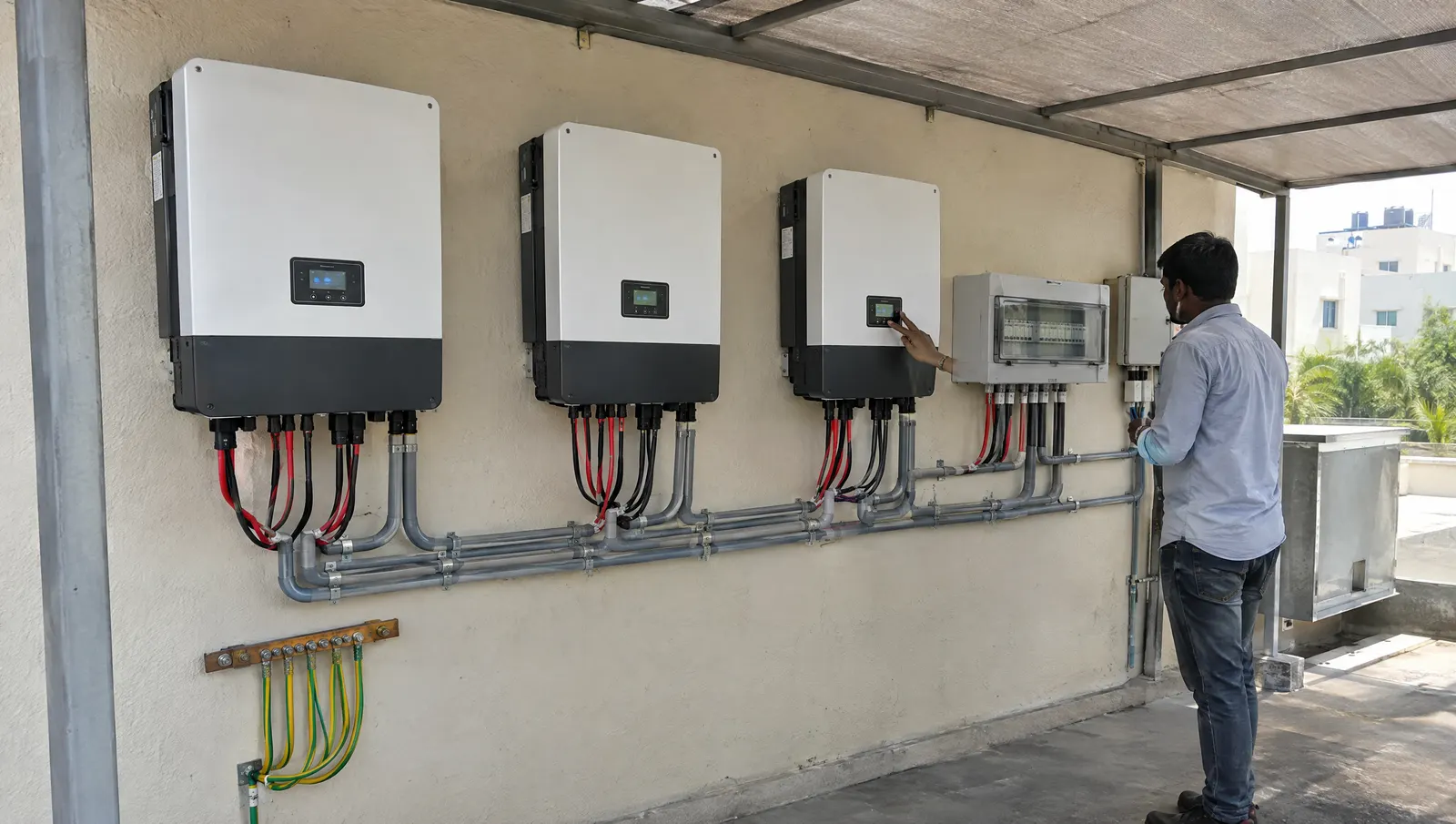
String inverters and an AC combiner box at an Indian commercial solar installation, recorded together with panels and structure as one asset block.
The Additional 20% Depreciation: Handle With Caution
A separate provision under Section 32(1)(iia) allows an additional 20% depreciation on new plant and machinery in certain cases. Some sources present this as automatically stacking on top of the 40% solar rate for a 60% first-year benefit.
In practice, this additional depreciation is conditional. It does not apply to businesses that have opted for the concessional corporate tax regime, and its applicability to power-generation assets specifically varies by case. Because this directly affects a company's tax filing, it should be confirmed with a chartered accountant against the business's specific tax regime before it's factored into any savings projection, rather than assumed as a default.
What This Means For Overall Solar Economics
For a profitable, tax-paying business on the CAPEX route, accelerated depreciation typically improves payback period meaningfully by returning a large tax saving within the first one to two years of operation, rather than spreading the benefit evenly across the plant's lifespan.
This is one of the reasons CAPEX ownership remains attractive for businesses with sufficient taxable profit to absorb the deduction. The benefit has limited value for a business with low or negative taxable income in the relevant year, since there's little tax liability to offset against.

Chartered accountant working through a fixed asset register and invoices for a solar plant claim.
Documentation A Business Will Need
To claim this deduction without issues at audit, a business typically needs:
- Commissioning certificate confirming the exact date the plant was put to use
- Purchase invoices and payment records for the full asset cost
- DISCOM or net-metering approval documents, where applicable
- Fixed asset register entry treating the solar plant as a single asset block, rather than splitting panels, inverters, and structure into separate categories
Questions buyers ask us.
Solar power systems qualify for 40% depreciation per year under the Written Down Value method, under Section 32 of the Income Tax Act.
No. It applies only when the business owns the solar asset outright, typically under a CAPEX structure. PPA, OPEX, and leased systems remain on the developer's or financier's books.
If commissioned on or after 1 October, the plant is treated as used for less than 180 days, and the depreciation rate for that year is halved to 20% instead of 40%.
Not automatically. The base rate is 40%. An additional 20% exists under a separate provision but applies conditionally, and eligibility should be verified with a chartered accountant based on the business's specific tax regime.
Its value is limited in that scenario, since the deduction offsets taxable income, and a business with little tax liability has less to offset in the near term.
At PowerMore, we help businesses evaluating CAPEX ownership understand how accelerated depreciation fits into their overall solar economics, alongside guidance to involve their chartered accountant for the final tax treatment specific to their filings.
Talk to our team about structuring your solar investment for maximum tax efficiency.