
Solar O&M Contract Checklist: The Clauses That Protect Plant Performance
A solar O&M contract should fix scope, cleaning, response times, availability guarantees, spares and reporting. Here is a clear checklist for factory owners.
A solar plant is designed to run for 25 years, but the maintenance contract largely decides what it generates in year five. Dust, loose connections, inverter faults, and undetected hotspots reduce output gradually, and the losses compound before anyone notices.
Many O&M contracts are signed as a formality at commissioning. A contract that is vague on scope, response times, and responsibility for parts leaves the business bearing the cost when something goes wrong.
The Contract At A Glance
| Clause | What It Should Fix |
|---|---|
| Scope | Preventive, corrective, and predictive work, with exclusions named |
| Schedule | Task list and frequency for each activity |
| Module Cleaning | Method, frequency, water supply, and log |
| Response Times | Time limits by fault severity, and what ends the clock |
| Guarantees | Availability and performance commitments, with remedies |
| Spares | Who supplies and pays for parts |
| Reporting | Monthly performance report and monitoring access |
| Commercial Terms | Fee, escalation, term, and termination rights |
Which Solar Model Fits Your Business?
Capex, Opex PPA, or Open Access — get a site-specific recommendation with system size, savings, and payback in 24 hours.
Scope Of Work
The scope should cover three kinds of maintenance, and say plainly what is excluded.
| Type | Examples |
|---|---|
| Preventive | Cleaning, inverter servicing, tightening connections, structure checks, vegetation control, protection testing |
| Corrective | Replacing modules or inverters, fixing wiring and monitoring faults, storm damage repair |
| Predictive | Thermal imaging to find hotspots, tracking generation trends through monitoring systems |
A contract limited to cleaning is a cleaning contract, not an O&M contract.
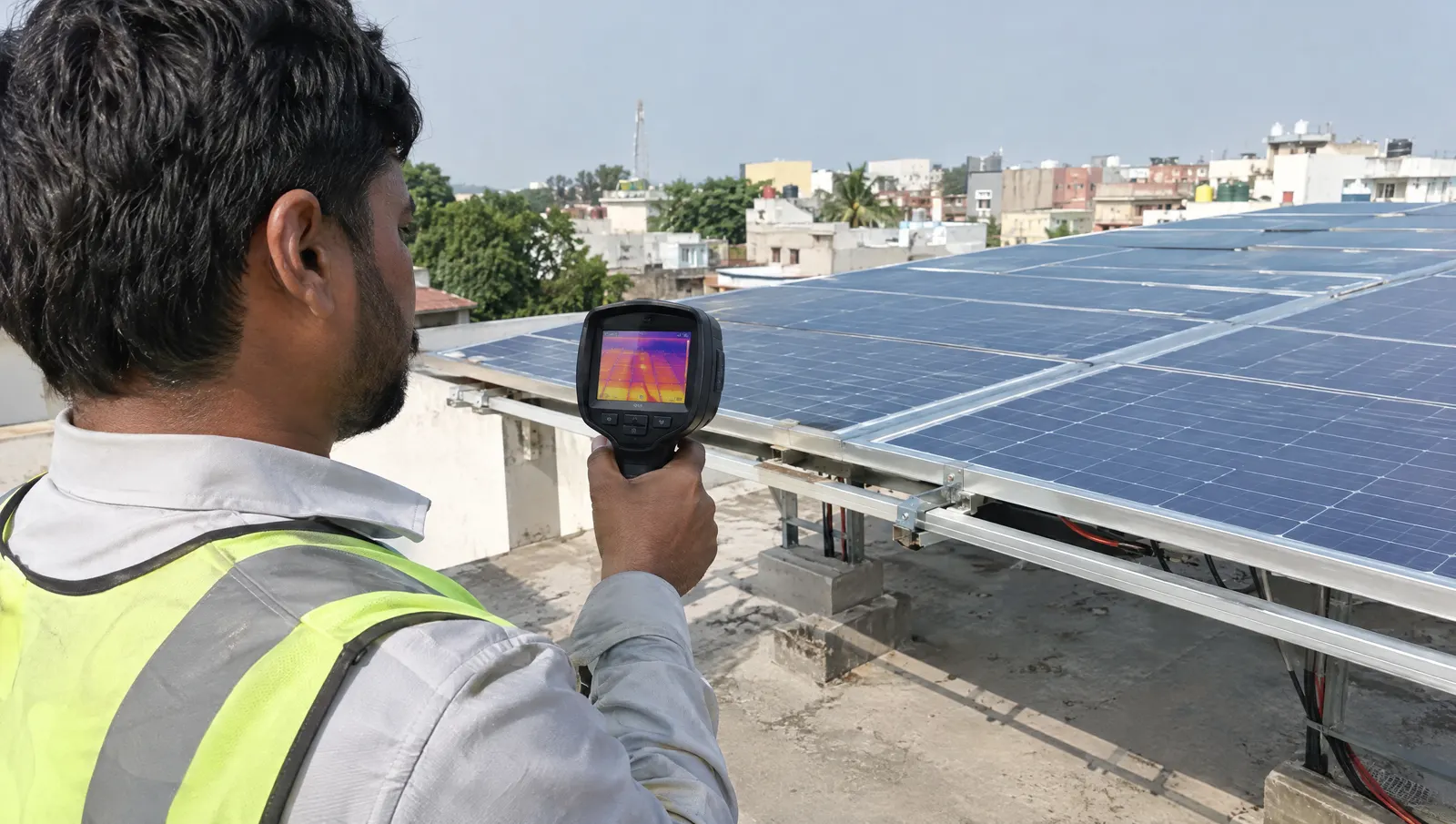
Technician scanning a rooftop solar array with a handheld thermal camera to find hotspots, a core predictive maintenance task.
Maintenance Schedule
The agreement should list activities and frequencies, not just refer to "regular maintenance."
| Frequency | Typical Activities |
|---|---|
| Monthly | Inspect modules for dust, review inverter data, confirm monitoring works |
| Quarterly | Check connections, cables, and junction boxes; review generation trends |
| Half-Yearly | Inspect inverters, transformers, and mounting structures; verify earthing and safety systems |
| Annually | Full inspection, thermal imaging, electrical testing, major equipment servicing |
Module Cleaning Terms
Cleaning frequency depends on the site. Plants in dusty regions need more frequent cleaning than those in cleaner areas. The contract should specify:
- Cleaning method, manual or robotic
- Who provides the water
- Frequency linked to measured soiling, not a fixed calendar alone
- Methods compliant with module warranty and IEC requirements
- A signed log for each visit
Response Times And Fault Severity
Faults should be classified by severity, with a response and resolution time for each. Market AMC offerings commonly quote fault response windows of 24 to 72 hours, and a plant-down fault should sit at the short end.
The contract should also state what stops the clock. In many contracts, response time ends when a technician arrives, not when the fault is fixed. Both should be defined.
Performance Guarantees
Availability
Service contracts commonly guarantee roughly 97-99% availability. The definition should state how it is calculated and which events are excluded, such as grid outages and force majeure. Delays in obtaining spare parts should not count as excluded events.
Performance Ratio
If a performance ratio guarantee is offered, it should be defined and set against the plant's modelled value from the design stage, with a stated allowance for degradation.
Independent operators are increasingly relying on availability and response-time commitments rather than performance ratio guarantees, so each should be read carefully for what it actually binds the contractor to deliver.
Liquidated Damages
Remedies should be explicit. Utility-scale practice caps liquidated damages in a range of about 5-20% of contract value, or roughly the annual O&M fee. Rooftop contracts vary, so the cap should be checked against the agreed fee.
Spares And Parts
The contract should state whether it is comprehensive, meaning parts replacement is included, or non-comprehensive, meaning labour only. The term is used inconsistently in the market, so it should be defined in the text.
- Owner-Supplied: The business buys and stores spares.
- Contractor-Managed: The contractor holds and replaces them.
- Hybrid: Costly items such as inverters are covered separately.
For utility-scale plants, a spares allowance of about 0.2% of module count and a 12-month warranty on replaced parts are used as benchmarks. A rooftop contract should still state who pays for an inverter replacement and how long it takes.
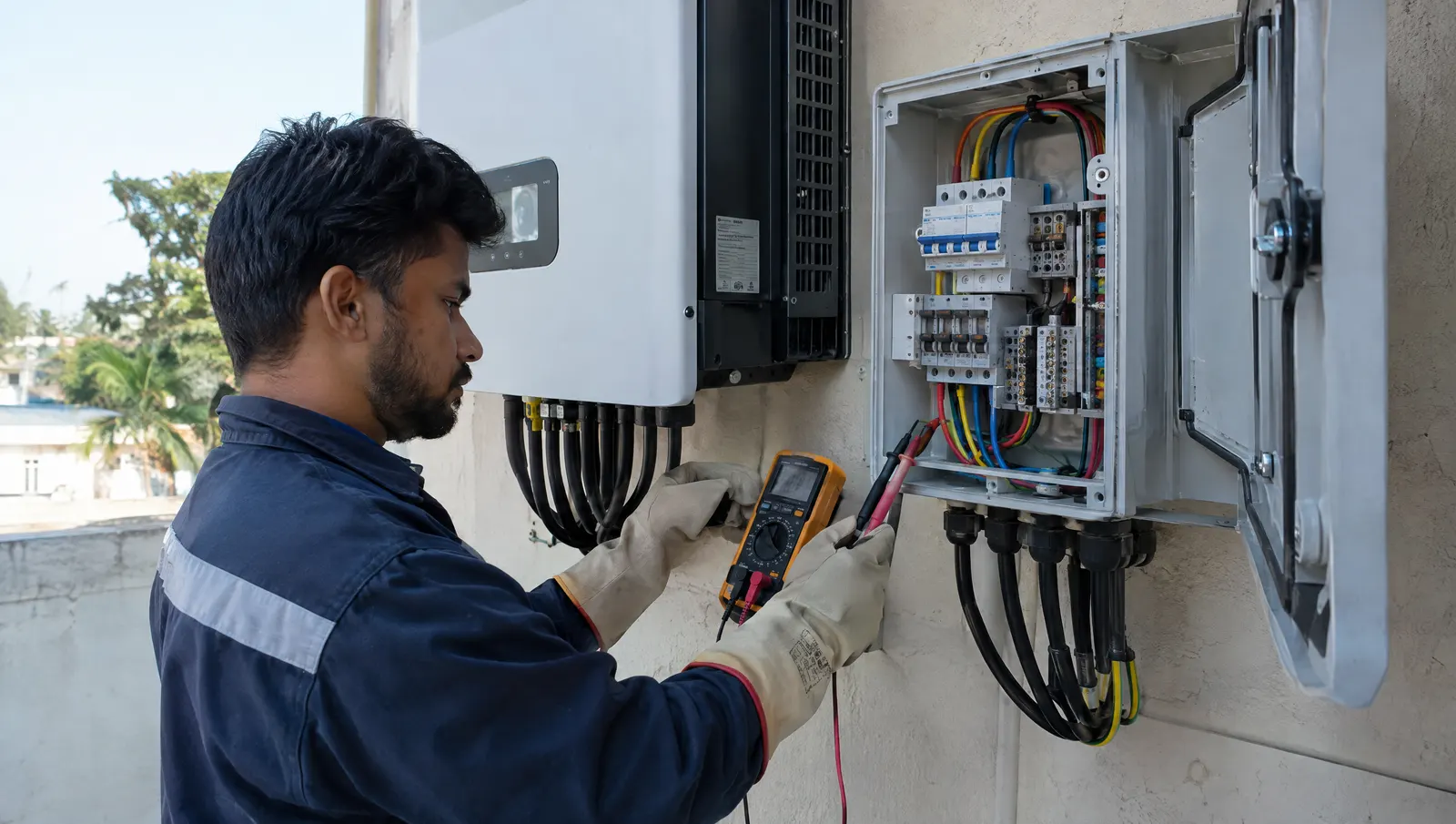
Technician in insulated gloves servicing a string inverter and its AC distribution box with a multimeter.
Monitoring, Reporting, And Warranty Support
- Monthly report with actual versus expected generation, performance ratio, availability, and fault log
- Access to the monitoring dashboard for the business
- Cleaning and inspection logs retained
- Support in raising manufacturer warranty claims, backed by documented maintenance
Well-documented maintenance matters because warranty claims can be rejected when records are missing.
Commercial And Legal Terms
- Fixed or variable fee, and the yearly escalation
- Payment schedule and any performance incentive
- Contract term, extension options, and the start date of service
- Termination rights and bank guarantee terms
- Ownership of monitoring data
- Insurance cover and safety compliance for work at height and on live electrical equipment
Red Flags In An O&M Proposal
- Cleaning is the only service listed
- The word "comprehensive" is used without a definition
- Response time ends when a technician arrives
- No monthly report or dashboard access
- Availability excludes spare-part delays
- No remedy if guarantees are missed
- No termination or handover terms
Questions buyers ask us.
It should cover preventive, corrective, and predictive maintenance, a scheduled task list, cleaning terms, fault response times by severity, availability guarantees, spares responsibility, monthly reporting, and commercial terms such as fees, escalation, and termination rights.
In practice the terms overlap. An AMC often means a scheduled annual contract, sometimes limited to cleaning and inspection, while O&M implies broader coverage including fault response, monitoring, and parts. The scope should be read rather than assumed from the name.
It depends on dust and weather at the site. Dusty locations need more frequent cleaning, and the contract should link frequency to measured soiling and keep a log of each visit.
Service contracts commonly guarantee roughly 97-99%. The calculation method and excluded events should be defined, and spare-part delays should not be treated as exclusions.
Only in a comprehensive contract. A non-comprehensive contract covers labour. The agreement should state who pays for inverters and other major components.
Under a PPA, the developer who owns the plant normally maintains it. Under lease or ownership models, the responsibility depends on the agreement, so it should be confirmed in writing.
PowerMore treats O&M as part of engineering, with defined schedules, response commitments, and performance reporting so that a plant's output can be checked against its design.
Ask for a detailed O&M scope to compare against this checklist.