
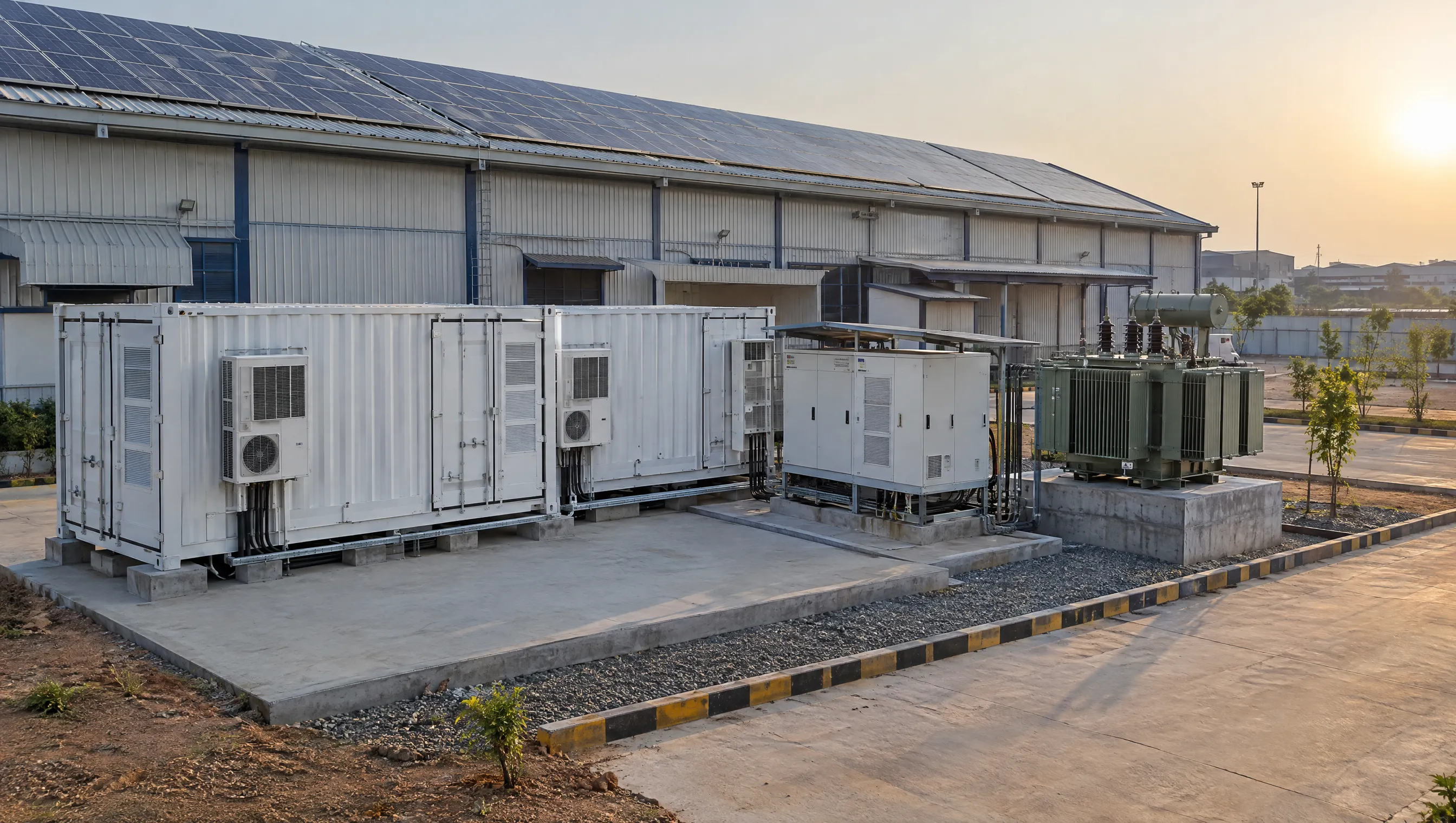
Battery Storage For Factories In India: Worth It In 2026?
Battery storage isn't a universal yes for every factory. Here's when it genuinely pays off in India in 2026, and when it doesn't.
For years, battery storage for Indian factories was treated as a future consideration: expensive, unproven at scale, and hard to justify against a payback-period spreadsheet.
That calculation is changing quickly.
What's Changed Since Last Year
A few shifts have moved battery storage from a "someday" item to an active procurement decision for many facilities.
Cell Prices Have Dropped Sharply
Lithium iron phosphate cell prices have fallen more than 40% over the past two years, pulling installed system costs down with them.
Government Support Has Scaled Up
Standalone battery storage projects can now access government Viability Gap Funding covering up to 40% of capital costs, reducing the upfront burden for early adopters.
Time-Of-Day Tariffs Are Now Live In Multiple States
Time-of-day tariff structures, which reward facilities for shifting consumption away from peak hours, are now active across several states, creating a direct financial incentive that didn't broadly exist before.
Utility-Scale Tariffs Have Fallen Sharply
Battery storage procurement tariffs in India have dropped roughly 86% since 2022, reflecting how quickly the underlying economics have matured.
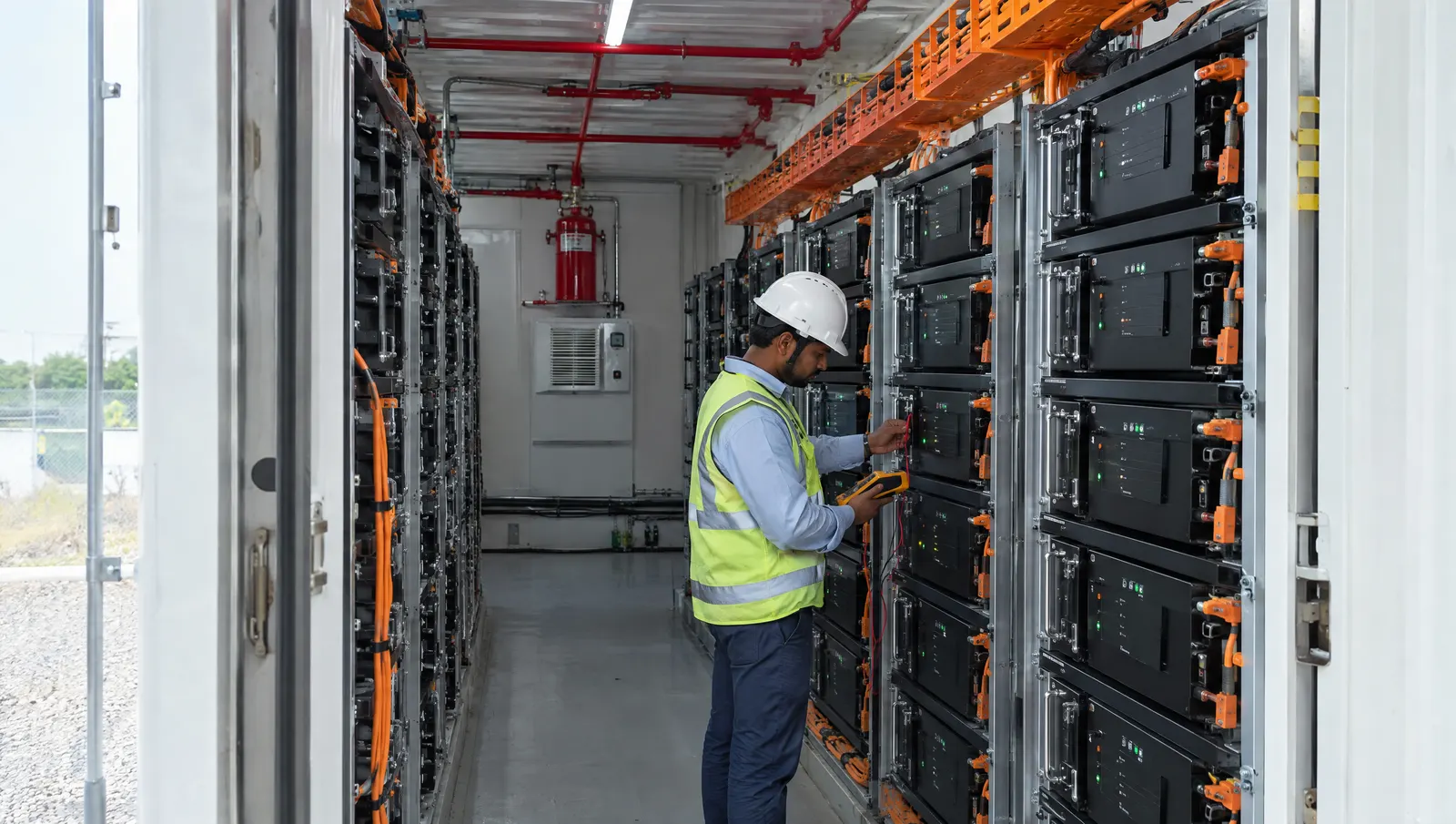
Technician inspecting rack-mounted LFP battery modules inside a battery energy storage container.
Which Solar Model Fits Your Business?
Capex, Opex PPA, or Open Access — get a site-specific recommendation with system size, savings, and payback in 24 hours.
What Battery Storage Actually Does For A Factory
Peak Shaving
Demand charges often form a large share of an industrial electricity bill. A battery charges during low-cost periods and discharges during high-demand windows, reducing the peak demand the facility draws from the grid.
Backup Power
Battery storage covers most short-duration outages, which account for the large majority of downtime in many Indian industrial belts, activating a backup generator only for extended outages. This can reduce generator run-hours substantially, cutting fuel and maintenance costs.
Solar Self-Consumption
For facilities with existing or planned solar, storage allows surplus daytime generation to be used after sunset, rather than being exported or curtailed.
Demand Charge Management
For factories with high contract demand, storage can reduce the risk of penalty charges triggered by short demand spikes.
Indicative Cost Range For India
| System Size | Approximate Installed Cost |
|---|---|
| 100-500 kWh | ₹25,000-40,000 per kWh |
| 2 MWh and above | ₹15,000-25,000 per kWh |
| 1 MWh system | Approximately ₹2.5-3.5 crore installed, including BMS, PCS, EMS, civil works, and commissioning |
Larger systems benefit from lower per-kWh costs due to scale, a factor worth accounting for when comparing quotes across different capacity sizes.
What Determines Payback Period
Payback timelines vary significantly based on:
- Tariff structure and how large the peak-to-off-peak price gap is in a specific state
- Contract demand and how frequently the facility hits penalty thresholds
- Number of outage hours currently covered by diesel generators
- Whether the system is paired with existing or planned solar
Facilities in high-tariff regions with strong peak-shaving potential tend to see faster payback, while facilities focused primarily on backup and reliability in lower-tariff regions typically see longer payback periods. This makes a facility-specific load and tariff study essential before sizing a system. A generic payback number is rarely accurate for a specific site.
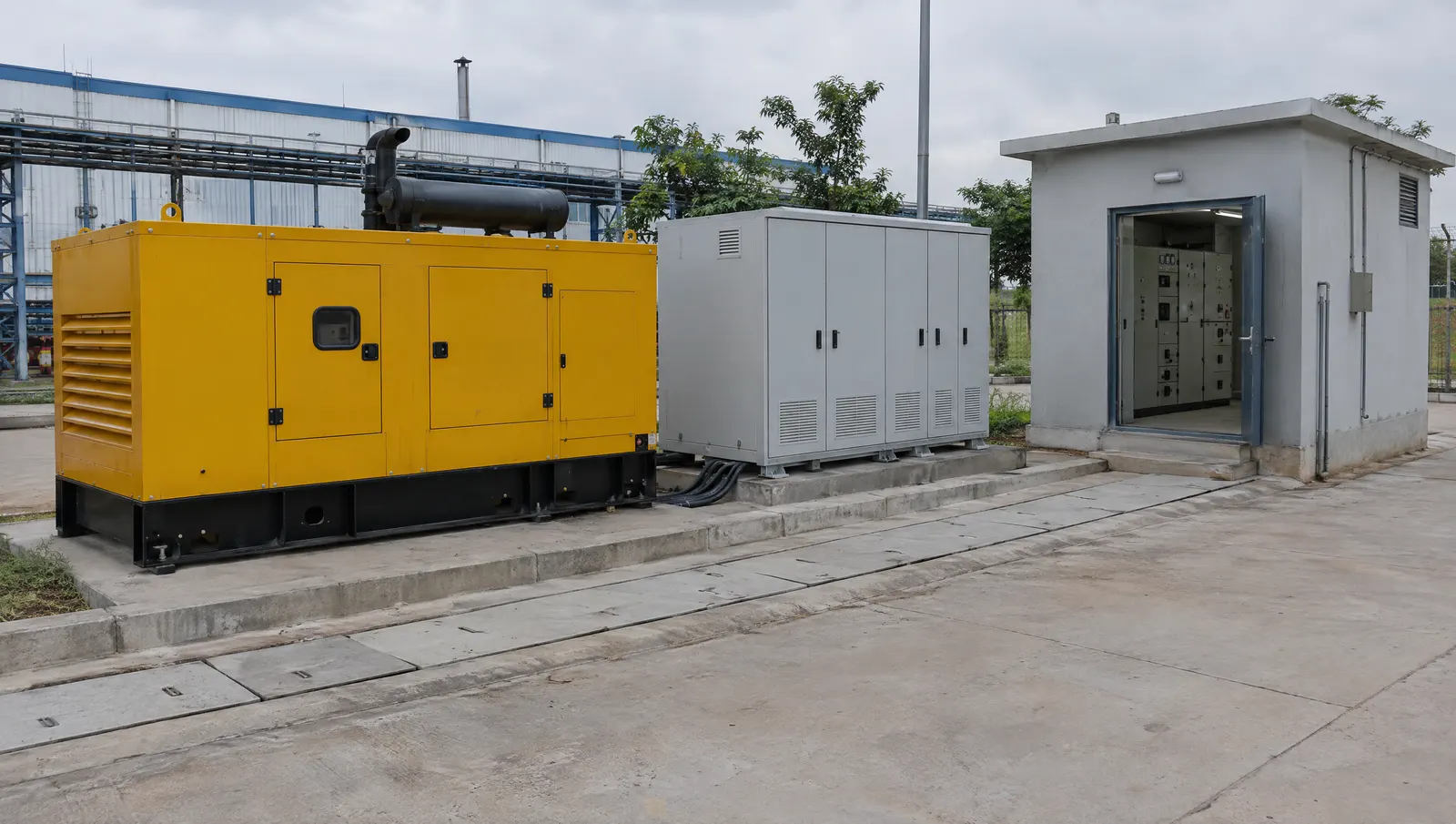
Diesel generator set next to an outdoor battery storage cabinet at an Indian manufacturing plant.
Financing Options For Battery Storage
CAPEX Ownership
Full ownership of the asset, maximum long-term savings, upfront investment required.
Storage-As-A-Service
A structure where a third party owns and operates the battery system, and the business pays through a service fee or tariff rather than upfront capital, similar in principle to how OPEX solar PPAs work.
Bundled With Solar
For businesses already evaluating rooftop or ground-mounted solar, storage can be added to the same project to maximize self-consumption and peak shaving together.
Who Should Evaluate Battery Storage First
Battery storage tends to make the strongest financial case for:
- Facilities with high demand charges relative to total electricity spend
- Facilities in states where time-of-day tariffs create a meaningful price gap between peak and off-peak hours
- Facilities currently running diesel generators for frequent short outages
- Facilities with existing solar looking to reduce evening grid dependence
For factories with low demand charges, minimal outage exposure, and no time-of-day tariff exposure, the payback case is weaker and should be evaluated carefully before investing.
Questions buyers ask us.
For many facilities, yes, particularly those with high demand charges, frequent short outages, or exposure to time-of-day tariffs. The right answer depends on a facility-specific load and tariff analysis.
Costs vary by system size, but installed costs generally fall in the range of ₹15,000-40,000 per kWh depending on scale, with larger systems benefiting from lower per-unit costs.
Payback typically ranges from a few years to several years, depending on tariff structure, demand charges, and outage frequency at the specific facility.
Yes. Pairing storage with solar allows a facility to use surplus daytime solar generation after sunset, improving overall self-consumption.
Not entirely. Battery storage covers most short-duration outages, but a generator is typically still needed for extended outages.
At PowerMore, we evaluate battery storage as part of a facility's broader energy strategy, assessing demand charges, tariff structure, and outage patterns before recommending a system size or financing model.
Speak to our team to assess whether battery storage makes sense for your facility.