
Battery Storage For Indian Factories: Where The Payback Actually Comes From
Industrial battery storage in India pays back fastest where demand charges, ToD tariffs and diesel use are high. See costs, savings and who should hold off.
Published payback figures for commercial battery storage in India range from 3-6 years to 8-12 years. Both can be correct. The gap comes from what the battery is asked to do and what the facility pays for electricity.
A battery energy storage system (BESS) earns money only through specific tariff and reliability mechanisms. A factory that knows which of them apply to its bill can estimate whether industrial battery storage is worth it in 2026. A factory that does not will likely be guessing.
The Short Answer
Battery storage for factories is worth evaluating seriously where demand charges are high, time-of-day (ToD) peak premiums are meaningful, or diesel gensets run regularly. It is a weak case where load is flat, demand charges are low, and the grid is stable.
| Facility Profile | Case For Storage |
|---|---|
| High demand charges, repeated contract-demand exceedance | Strong |
| Daily genset use for short outages | Strong |
| ToD peak premium of 20% or more, with solar already installed | Moderate to strong |
| Cold storage or process loads where one outage destroys inventory | Strong (reliability value) |
| Flat load, low demand charge, stable grid | Weak |
| ToD premium under 10% and no demand-charge problem | Weak |
Peak shaving is often the largest line item because solar alone does not reduce a demand charge reliably. A cloudy hour can still set the monthly peak.
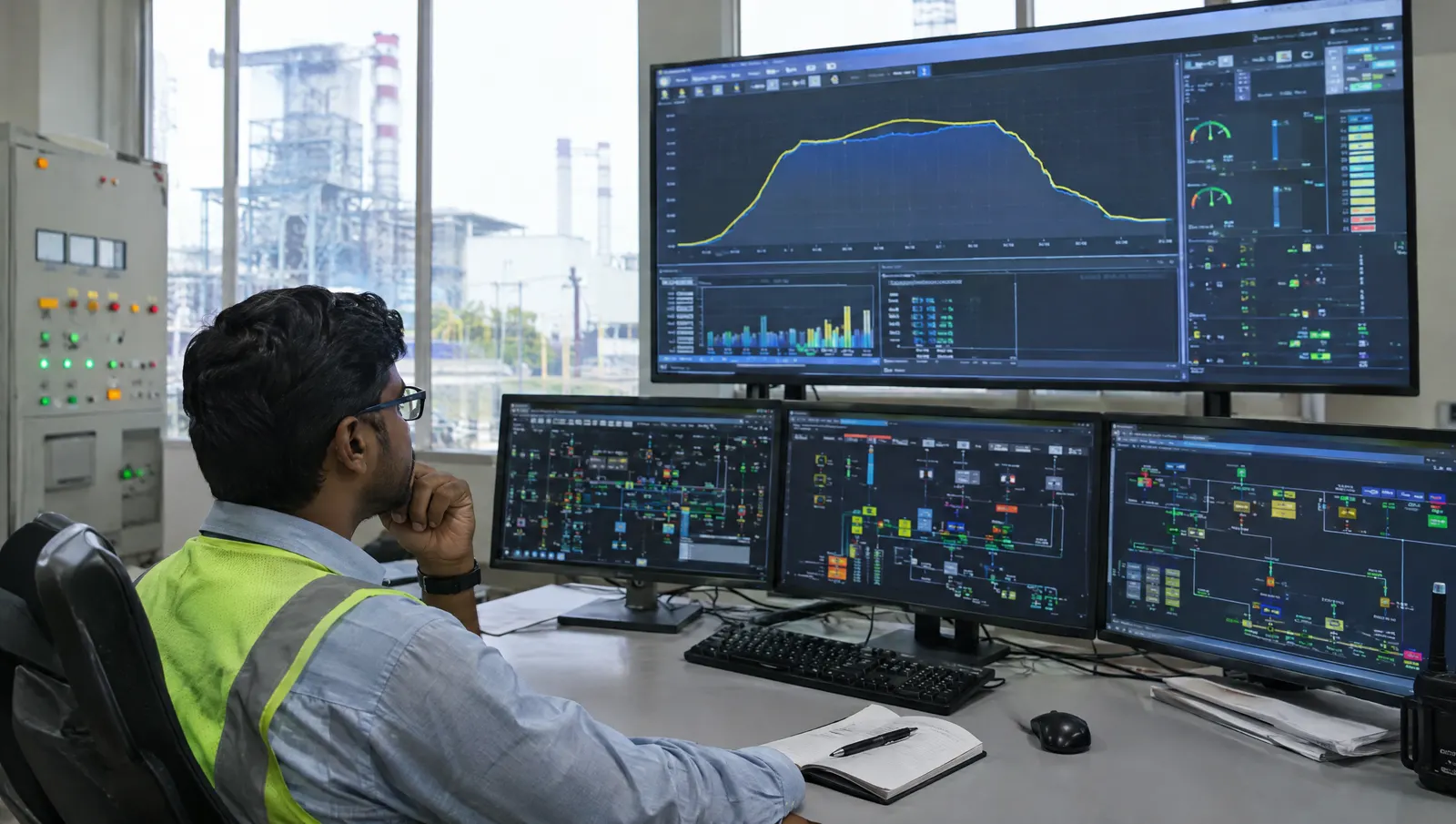
Control room engineer at an Indian plant watching a daily load curve, the data that shows how sharp the peaks really are.
Which Solar Model Fits Your Business?
Capex, Opex PPA, or Open Access — get a site-specific recommendation with system size, savings, and payback in 24 hours.
What Changed In 2026
ToD Tariffs Are Now Widespread
ToD tariffs are mandated for commercial and industrial consumers above 10 kW, and states are now applying them. Bihar bills peak hours (5-11 PM) at about 120% of the normal tariff and off-peak hours (9 AM-5 PM) at 80%. Odisha introduced ToD from 1 July 2026, with solar hours 10% lower and peak hours (6 PM-12 AM) 10% higher. Jammu & Kashmir applies a 20% peak surcharge to industrial consumers.
Banking Rules Are Tightening In Some States
Maharashtra has moved toward allowing banked solar energy to be drawn only within the same ToD slot, which raises the value of storage for solar owners there. The status of these rules should be confirmed before relying on them.
Battery Prices Have Not Fallen Steadily
Cell prices rebounded in 2026 after a sharp 2025 decline. A business waiting for prices to keep falling cannot assume they will.
What Industrial Battery Storage Costs
Published installed-cost figures for commercial and industrial systems range widely, from roughly ₹10,000 to over ₹60,000 per kWh. Size, discharge duration, and scope drive the spread. Larger systems cost less per kWh, and quotes that include power conversion, energy management software, civil works, fire protection, and commissioning cost more than cell-and-cabinet pricing.
Costs should be compared on an identical scope, and verified with current quotes rather than a published range.
An Illustrative Battery Storage Payback Calculation
Assumptions: a 500 kWh battery that shaves 200 kVA of peak demand at a demand charge of ₹300 per kVA per month, and shifts 500 kWh a day across a ₹2 per unit ToD spread for 300 days a year.
- Demand charge saving: ₹7.2 lakh a year
- ToD saving: ₹3.0 lakh a year
- Total: about ₹10.2 lakh a year
| Installed Cost | System Cost | Simple Payback |
|---|---|---|
| ₹12,000 per kWh | ₹60 lakh | About 5.9 years |
| ₹20,000 per kWh | ₹1 crore | About 9.8 years |
| ₹30,000 per kWh | ₹1.5 crore | About 14.7 years |
This is simple payback only. It excludes operating costs, degradation, financing, and tax effects. The same savings produce very different outcomes depending on capital cost, which is why a single published payback figure says little about a specific site.
When Storage Is Not Worth It Yet
- Demand charges are low relative to total electricity spend
- The load profile is flat, so there are no sharp peaks to shave
- ToD premiums are small and no solar is installed to charge the battery cheaply
- The grid is reliable and diesel use is minimal
- The simple payback exceeds the battery's warrantied life
In these cases, solar alone, or load management, usually delivers more per rupee invested.
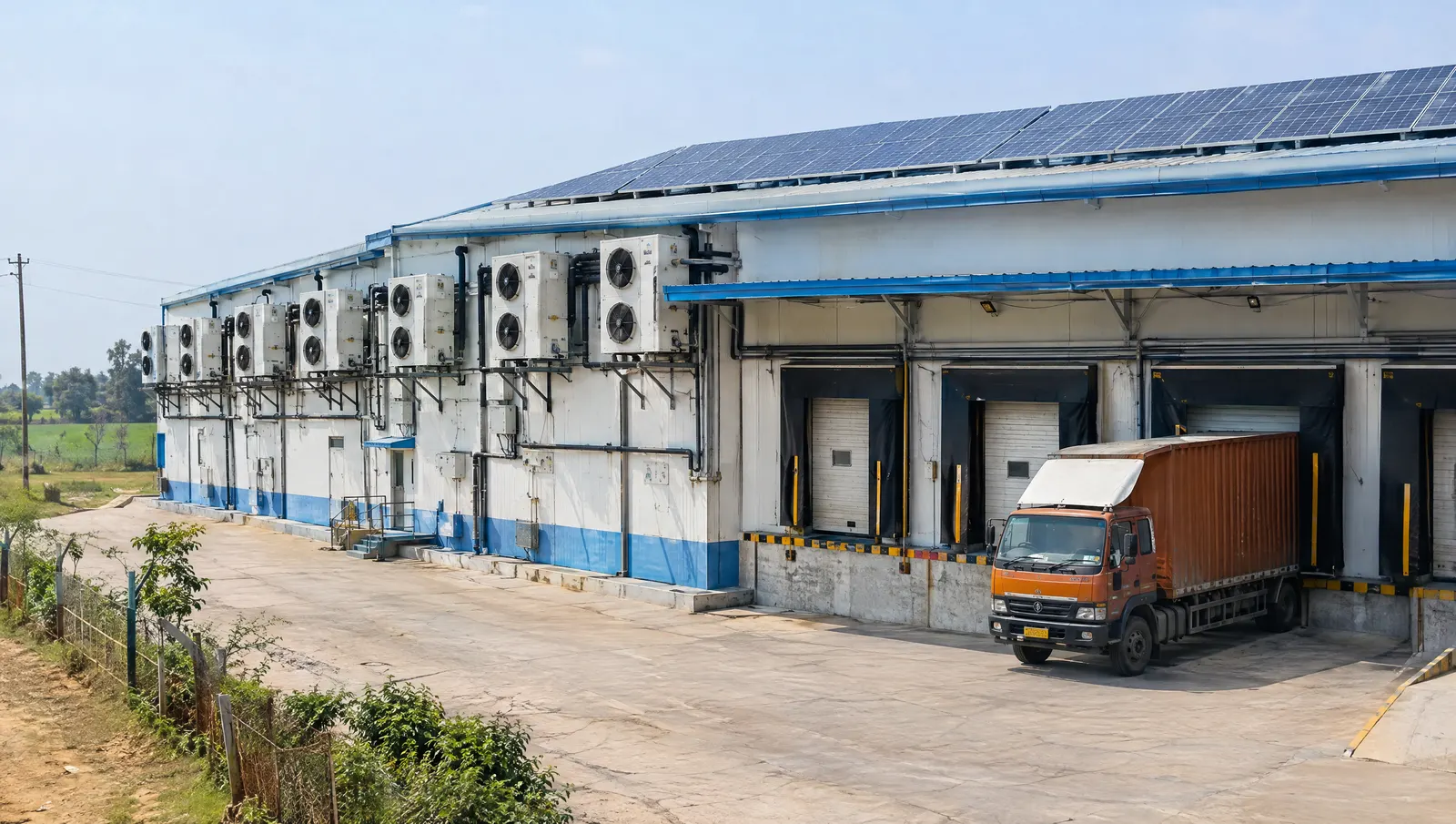
Cold storage warehouse in rural India, the kind of site where one outage can destroy inventory and storage earns its keep on reliability.
What To Check Before Deciding
- Interval Load Data: 15 or 30 minute data shows how sharp the peaks actually are. Monthly bills hide this.
- Tariff Structure: Demand charge, ToD slabs, and penalty rates for exceeding contract demand.
- Power And Energy Rating: A battery with enough kWh but too little kW cannot shave a sharp peak, and one with high kW but low kWh runs out mid-peak.
- Cycle Life And Warranty: A battery cycled daily works much harder than a backup battery, so warranty terms on cycles and retained capacity matter.
- Site Requirements: Space, ventilation, and fire protection provisions.
- Ownership Model: Outright purchase, or a subscription-based storage-as-a-service arrangement where a third party owns the system and the factory pays a service fee.
Questions buyers ask us.
It depends on the tariff and load. Facilities with high demand charges, frequent contract-demand exceedance, daily genset use, or large ToD peak premiums tend to see a workable case. Facilities with flat loads and low demand charges usually do not. An interval-data study should come before any decision.
Published figures range from roughly 3-6 years to 8-12 years. The difference comes from installed cost per kWh, demand charges, ToD spreads, and whether the battery also displaces diesel. A site-specific calculation is the only reliable answer.
Industrial tariffs bill the maximum demand recorded in a month. The battery discharges during the highest-demand intervals, lowering that recorded peak. The saving depends on how sharp the peaks are and whether the battery is sized to cover their full duration.
Batteries cover short outages well and can reduce genset run-hours. Extended outages still need a generator, so storage typically reduces genset use rather than eliminating it.
No. Peak shaving and backup work without solar. Solar adds value by charging the battery at lower cost and by storing surplus daytime generation for evening use.
Yes. In this model a third party owns and maintains the system, and the factory pays a service fee instead of the upfront capital. Terms, performance guarantees, and contract length should be reviewed carefully.
PowerMore sizes storage from a facility's interval load data and tariff structure, and recommends it only where the numbers support it. Where solar alone or load management delivers more value, that is what the assessment will say.
Share your load data to check whether storage pays off at your facility.