
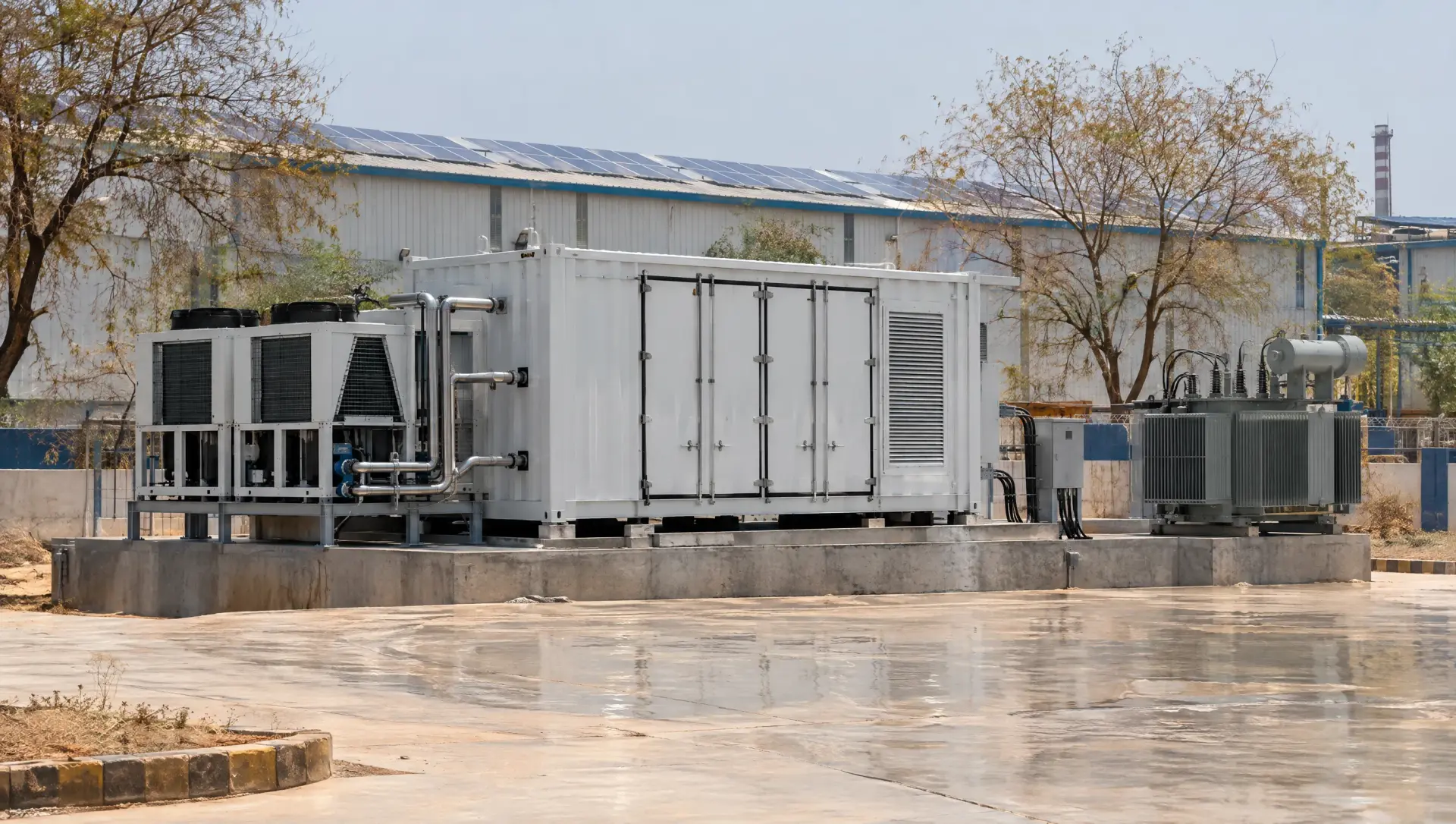
Commercial Battery Storage Lifespan: What Indian Conditions Do To A Battery
Solar battery life in a factory is typically 12 to 15 years for LFP, less in heat or heavy cycling. See what sets lifespan and what a warranty should cover.
A solar panel is sold on a 25-year life. Solar battery life has no such single number. A battery wears out in two ways, with use and with time, and Indian heat speeds up the second.
For a factory comparing payback against a battery's life, the useful question is not how many years the brochure claims. It is which limit the battery will hit first on that site.
Expected Life In Indian Conditions
Most commercial systems in India use lithium iron phosphate (LFP) cells. Published ranges for LFP are:
| Measure | Typical Range | What It Means |
|---|---|---|
| Rated cycle life | 5,000-8,000 cycles | Assumes controlled temperature |
| Calendar life | About 12-15 years | Ageing that happens even when idle |
| Capacity loss over ten years | About 20-30% | Grid-scale LFP, good operation |
Whichever limit arrives first sets the system's useful life. Both ranges are indicative, and each manufacturer's datasheet and warranty state the actual terms.
Which Solar Model Fits Your Business?
Capex, Opex PPA, or Open Access — get a site-specific recommendation with system size, savings, and payback in 24 hours.
Two Ways A Battery Ages
Cycle Ageing
Each charge and discharge cycle wears the cells. The wear grows with the number of cycles, how deeply the battery is discharged, and how fast it is charged.
Calendar Ageing
Cells also age with time, even when idle. It is faster at high state of charge and at high temperature.
Which Limit Comes First
How often the battery cycles decides whether cycle life or calendar life is the limit. At 330 cycling days a year:
| Cycles Per Day | Cycles Per Year | Years To Use 5,000-8,000 Cycles |
|---|---|---|
| 1 | 330 | About 15-24 years |
| 1.5 | 495 | About 10-16 years |
| 2 | 660 | About 8-12 years |
For a battery cycling once a day, calendar life and heat are likely to set the limit. At two cycles a day, the cycle count runs out first. This is simple arithmetic on the ranges above, not a guarantee.
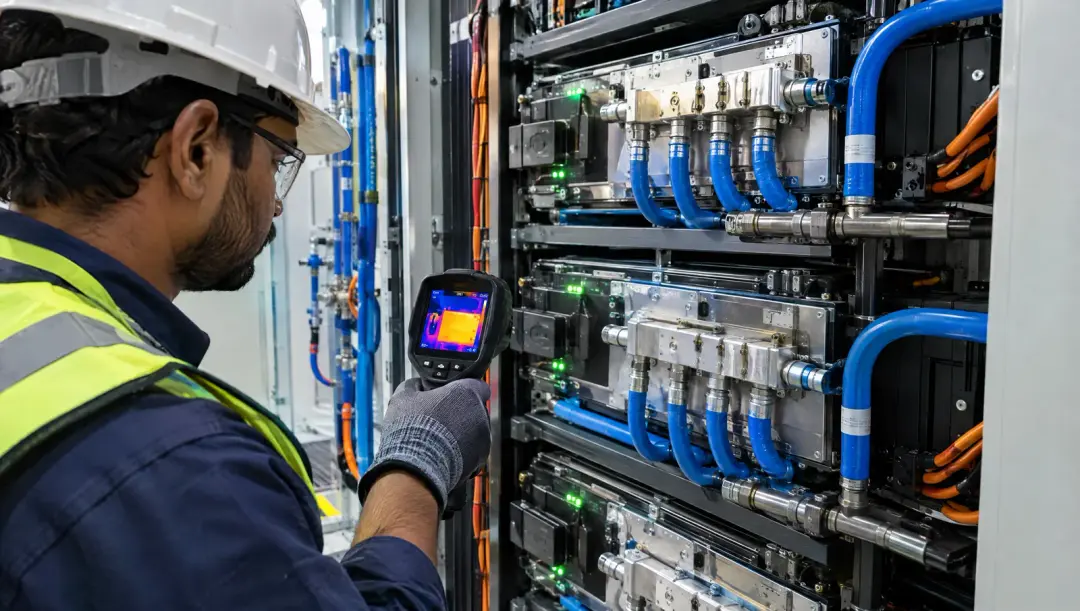
Technician checking liquid-cooled LFP battery modules with a thermal camera inside a storage container.
How Indian Conditions Affect Life
Heat
Ambient temperatures in interior and coastal plains regularly reach 40-50°C in summer. Temperature is described as the biggest single driver of battery ageing. The 5,000-8,000 cycle ratings assume controlled temperature, and sustained operation in unmanaged high ambient heat shortens life materially.
Thermal Management
| Option | Strength | Limitation |
|---|---|---|
| Air cooling | Lower cost, simple, low maintenance | Less effective in high heat and at high density |
| Liquid cooling | Better temperature uniformity, suited to hot regions and dense systems | Higher cost, pumps add auxiliary load, needs leak checks |
Cooling should be designed for peak temperatures, not averages. Undersized or failed cooling during a heat event also raises safety risk.
Humidity, Dust, And Monsoon
Coastal sites call for corrosion protection. Monsoon flooding is a site risk, so drainage and waterproofing need to be part of the design.
How Operation Changes Lifespan
| Factor | Effect On Life | Common Practice |
|---|---|---|
| State of charge | Long periods near full or near empty speed ageing | Operate within roughly 20-80% |
| Depth of discharge | Deeper discharge wears cells faster over many cycles | Avoid unnecessary deep cycles |
| Charge and discharge rate | Higher rates add stress | Many operators stay at or below 0.5C |
| Cycles per day | More cycles use life sooner | Match cycling to the revenue it earns |
| Temperature | Biggest single factor | Active thermal control |
A battery used for daily peak shaving works much harder than one held for backup. A system sized larger than needed can cycle less deeply and last longer, at a higher upfront cost.
What Reduced Capacity Means In Practice
A battery does not stop at the end of its life. It delivers less usable energy each year.
- A 500 kWh battery that has lost 25% holds roughly 375 kWh
- Peak shaving depends on both kW and kWh, so lower capacity may mean it can no longer cover the full peak
- Round-trip efficiency is cited at about 88-92%, and some energy is lost in every cycle
Payback calculations should use declining capacity, not the day-one figure.
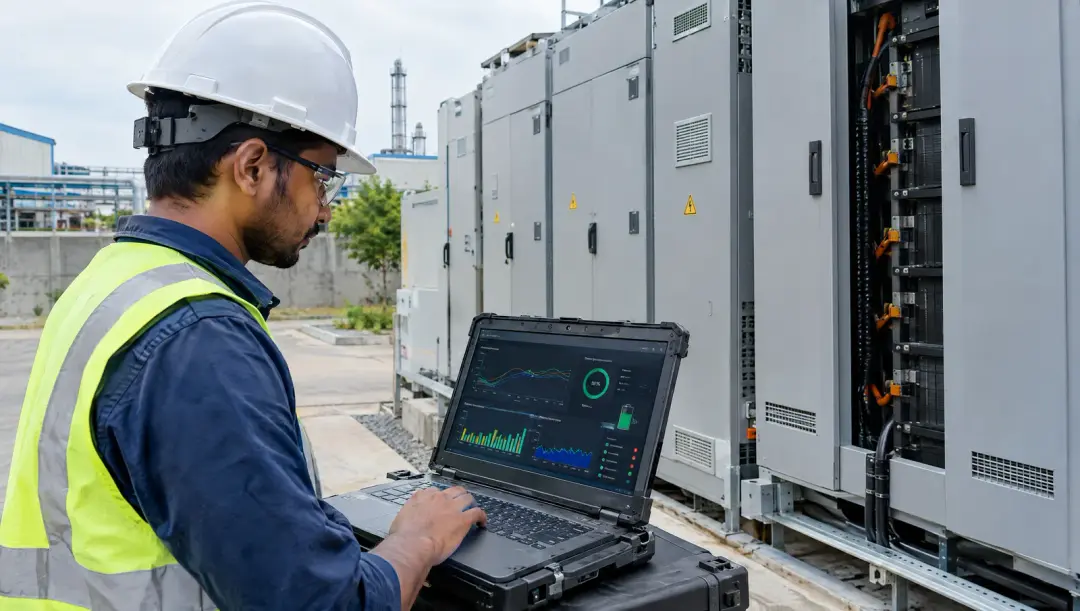
Engineer reviewing battery temperature and state-of-charge data from the battery management system beside outdoor battery cabinets.
What To Check In A Battery Warranty
- End-Of-Life Threshold: The capacity level at which the warranty counts the battery as worn out.
- Time And Cycle Limits: Whichever is reached first usually ends cover.
- Daily Cycle Allowance: Whether the warranty assumes the cycling the project actually needs.
- Operating Temperature Limits: Conditions under which cover applies, including site ambient.
- Cooling Requirements: Whether the warranty depends on the thermal management design.
- Capacity Testing: Who measures capacity, and how.
- Remedy: Replacement, repair, or augmentation with extra capacity.
- Monitoring Data: Access to battery management system records.
What Happens After The Battery's Life
- Some systems add capacity over time to offset fade
- Cells may be replaced while the power electronics and enclosure continue
- End-of-life batteries need responsible disposal or recycling
These costs belong in the lifecycle comparison between buying and a service model.
Questions buyers ask us.
LFP systems are commonly cited at roughly 12-15 years of calendar life and 5,000-8,000 cycles. Actual life depends on temperature, cycling frequency, depth of discharge, and cooling design.
Yes. Heat is the biggest driver of battery ageing, and rated cycle life assumes controlled temperature. Sustained high ambient temperatures without active cooling shorten life materially.
Published ratings are about 5,000-8,000 cycles, under controlled conditions. At one cycle a day, that is well over a decade of cycling, though calendar ageing may still limit life.
It suits hot regions and dense systems because it keeps temperatures more uniform, but costs more and needs maintenance. A thermal analysis of the site should decide.
It declines gradually. Grid-scale LFP in good operation loses roughly 20-30% over ten years, so a system delivers less usable energy each year.
Capacity can often be added or cells replaced while the rest of the system stays. The warranty and contract should state how.
PowerMore sizes storage around the site's heat, daily cycling and warranty terms, so that expected battery life matches the payback case.
Ask us to review the lifespan and warranty terms of any battery quote.